



By Oshri Cohen, CEO, Cybord AI
For decades, procurement of electronics for critical industries such as defense, data centers and industrial controls relied heavily on paper trails to ensure only authorized components made it into products. Standards such as IPC-1782, counterfeit avoidance requirements under DFARS 252.246-7007/7008, and broader supply-chain guidance including NIST SP 800-161 have progressively strengthened traceability and supply-chain risk management.
What began as an effort to combat counterfeit electronic parts has evolved into something much broader: hardware provenance – the ability to prove where critical hardware originated, who manufactured it, and whether unauthorized, substituted or counterfeit components have entered the defense supply chain.
The proposed DFARS Case 2022-D011 is the next major milestone in that evolution.
At first glance, the proposal simply prohibits the Department of War from acquiring products containing covered printed circuit boards (PCBs) manufactured by prohibited sources. In reality, it signals a fundamental shift in how trust will be established across the defense electronics ecosystem.
Each regulatory milestone has expanded what must be trusted. Counterfeit avoidance evolved into trusted sourcing, trusted sourcing into broader supply-chain risk management, and now into hardware provenance. DFARS Case 2022-D011 is the next logical step: moving beyond documentation toward objective proof.
The change reflects growing national-security concerns. As defense systems increasingly rely on globally sourced electronics, paperwork alone is no longer sufficient. Contractors are now expected not only to collect provenance data, but to verify it – using independent evidence rather than declarations. Trust can no longer be assumed. It must be proven.
DFARS Case 2022-D011 – An Important Step – But Only the Beginning
The proposed rule significantly strengthens assurance around where the PCB originated. It says far less about what gets assembled onto it.
Yet the greatest supply-chain risks – counterfeit devices, unauthorized substitutions, diverted inventory and non-approved components – typically enter during component sourcing and assembly.
The regulation secures the foundation. What comes next is securing the components mounted on it. Organizations that prepare today will be better positioned not only for current compliance requirements, but also for the inevitable expansion of provenance requirements to the component level.
Documentation Describes Intent. Hardware Provides Evidence.
Traditional inspection technologies such as Automated Optical Inspection (AOI) and X-ray remain indispensable, but they answer manufacturing questions – not provenance questions. AOI verifies assembly quality. X-ray verifies hidden solder joints. Neither confirms whether the installed component is authentic, approved or even the correct device.
Until recently, provenance depended almost entirely on documentation: purchase orders, certificates, approved vendor lists and traceability records. These remain essential, but they describe what was intended to be built—not necessarily what was actually assembled.
Recent advances in Visual AI introduce another source of evidence: the hardware itself.
A new analysis by Cybord highlights why this matters. After declining for five consecutive months, the share of China-origin components identified on electronics destined for AI infrastructure increased by nearly 50% month-over-month in June 2026.
Whether driven by supply shortages, pricing pressures or changing sourcing strategies, the data illustrates how rapidly the composition of assembled hardware can change, and why documentation alone cannot always provide a complete picture.
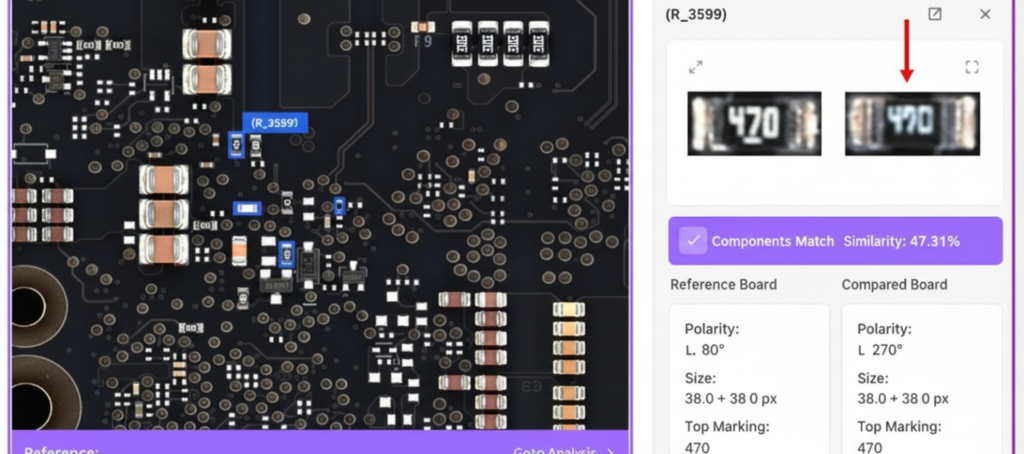
Visual AI addresses this challenge by analyzing the physical characteristics of every installed component. Markings, package geometry, surface finish, typography, logos and countless other manufacturing signatures become measurable evidence. Trained on billions of manufacturing observations, Cybord’s AI learns what “normal” looks like for a given component and identifies deviations that may indicate counterfeit devices, unauthorized sourcing, substitutions or other anomalies. Instead of relying solely on documentation, manufacturers can now verify the physical hardware itself.
The Next Competitive Advantage Will Be Proof
DFARS Case 2022-D011 is more than another procurement rule. It reflects a tectonic shift in how the defense industry defines trust.
For decades, organizations have invested in trusted suppliers, approved sourcing and documentation. Increasingly, competitive advantage will belong to manufacturers that can prove – not simply document – that every assembled product contains the correct, authentic and approved hardware.
For the first time, Visual AI, such the solution offered by Cybord, makes that possible at production scale, providing image-based evidence that the hardware delivered matches the hardware that was designed, approved and intended to be built.
The electronics industry has spent years improving trust in the supply chain.
The next frontier is no longer trusted suppliers.
It is trusted hardware.