



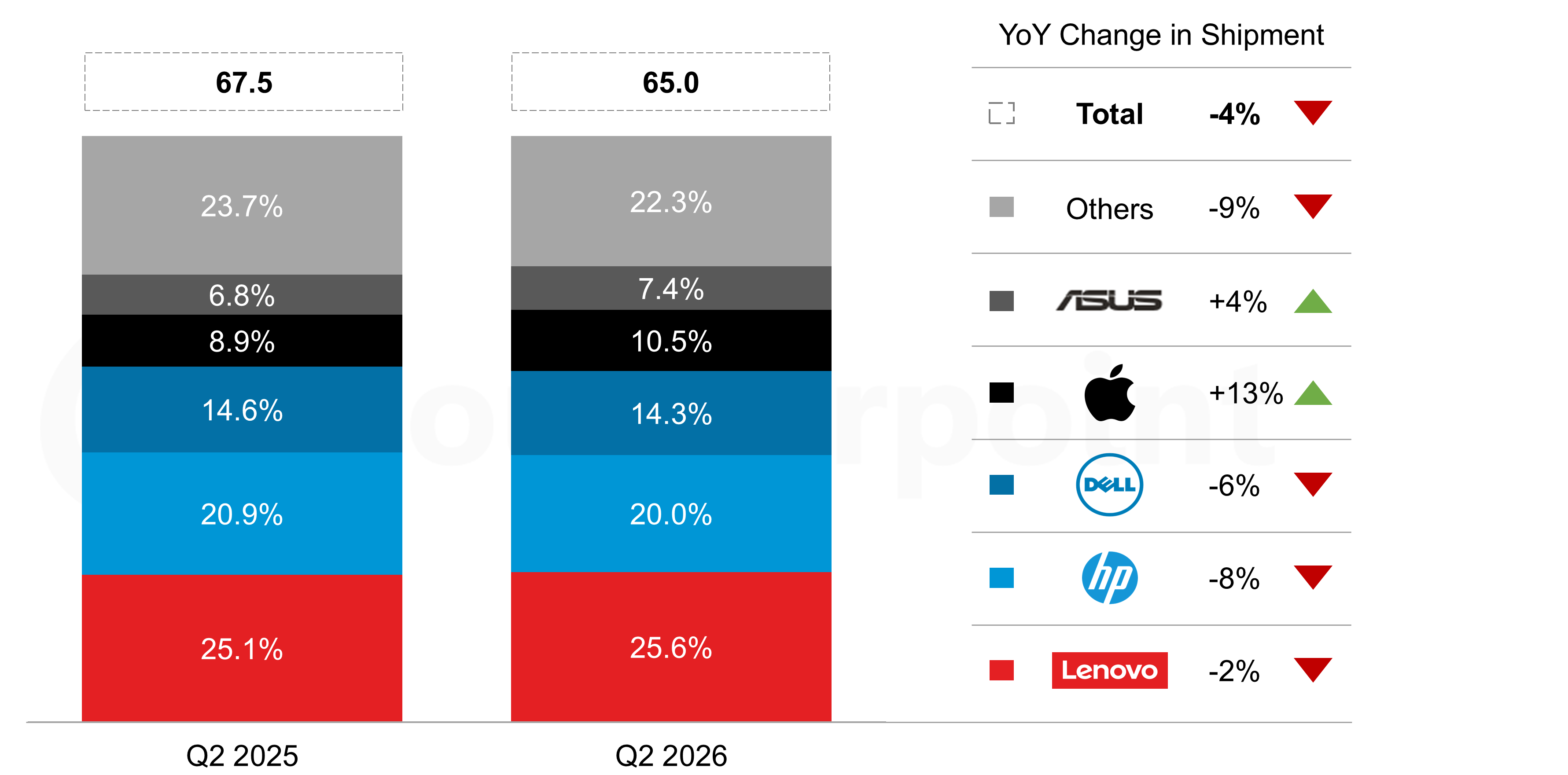
- Global PC shipments decreased by 4% YoY in Q2 2026 to reach 65 million units, breaking a growth trend that began in Q1 2025, as rising component costs, particularly for memory, began to suppress shipment volumes.
- While Lenovo, HP and Dell maintained their market dominance despite experiencing single-digit shipment declines due to memory-driven cost pressures, Apple and ASUS defied the downward trend with 13% and 4% YoY growth, respectively.
- Despite stabilized memory prices after Q2, elevated component costs are forcing PC OEMs to raise prices and suppress price-sensitive consumer demand, while the commercial sector remains resilient due to Windows-support-driven replacement cycles.
Seoul, Beijing, Berlin, Buenos Aires, Fort Collins, Hong Kong, London, New Delhi, Taipei, Tokyo – Global PC shipments decreased by 4% YoY in Q2 2026 to reach 65 million units, according to Counterpoint Research’s preliminary PC shipment data. This decline, which follows five consecutive quarters of growth beginning Q1 2025, reflects a changing market dynamic. While commercial refresh cycles tied to Windows migration and AI PC adoption continue to support demand, surging memory prices and higher component costs are increasingly constraining OEM production plans and suppressing consumer demand. The sharp increase in DRAM prices has significantly raised PC bill-of-material (BoM) costs, forcing OEMs to implement price increases, reduce entry-level configurations, or prioritize higher-margin premium systems.
Global PC Shipments by OEM, Q2 2026 (In Million Units)
 Source: Counterpoint Research Preliminary PC Shipment Data
The competitive landscape in Q2 2026 saw major players capitalizing on the refresh cycle, with several companies posting double-digit YoY percentage growth:
- Lenovo maintained its market leadership with a 25.6% share, despite shipments decreasing 2% YoY to 16.6 million units. Lenovo’s purchasing scale and deep supply chain relationships cushioned it from the worst of the memory shortage.
- HP showed the biggest drop among the top three players, with an 8% YoY decline in shipments. HP’s product mix remains highly exposed to the mainstream consumer and mid-range enterprise fleets, the exact segments most sensitive to the component-driven price hikes.
- Dell also turned downward with a 6% YoY decrease in shipments. Dell’s commercial focus shielded it from the dramatic collapse seen in pure consumer markets, capturing reliable enterprise IT budget dollars despite the macro headwinds.
- Apple’s successful launch of Neo helped the brand show enormous growth in this quarter, with shipments increasing 13% YoY.
- ASUS also showed strong momentum with 4% growth in shipments. The brand has been incredibly agile in adopting new silicon architecture. By being among the first to heavily back diverse AI PC formats (from mainstream Vivobook to high-end ProArt systems), ASUS has successfully captured early-adopter consumer mindshare.
Together, these top five vendors captured nearly 78% of the global PC market, underscoring continued consolidation at the high end. Smaller OEMs, by contrast, saw flat or declining volumes.
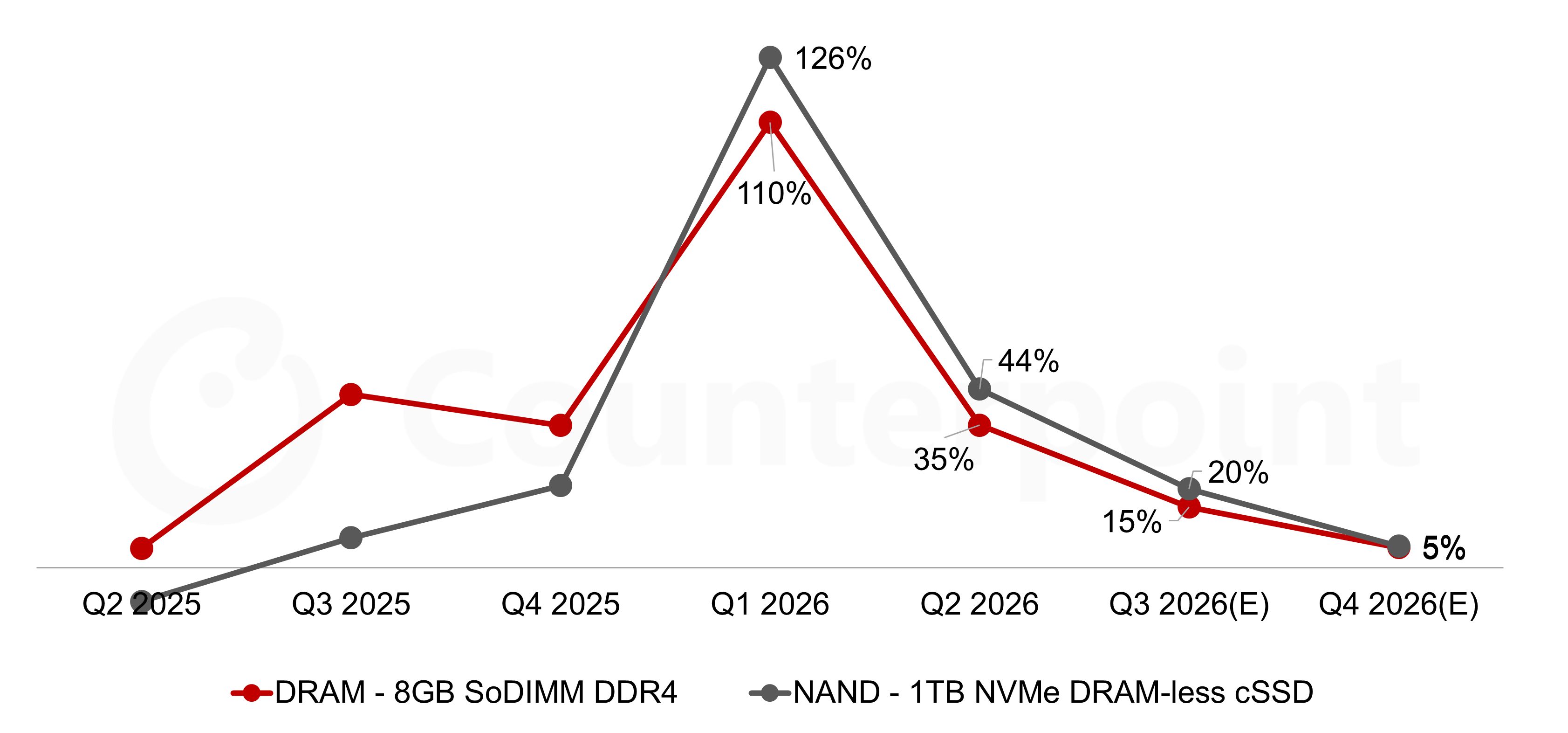
QoQ Price Trends for PC Memory, Q2 2025 – Q4 2026
 Source: Counterpoint Research Memory Price Tracker and Forecast *Prices in this report are based on the contract price.
Senior Analyst Minsoo Kang noted, “While memory prices have stabilized since Q2 following a sharp upward trend in Q1, the elevated cost remains a persistent burden for PC OEMs. We anticipate a significant contraction in demand within the price-sensitive entry-level and consumer segments. In contrast, the commercial sector is expected to maintain relatively resilient demand, largely driven by ongoing replacement cycles prompted by the end of Windows update support.”
Apple’s recent price increase seems to be an inevitable response to these cost increases. In the second half of the year, other PC OEMs are expected to continue to raise prices, and the overall ASP increase is expected to continue.
Associate Director David Naranjo said, “The memory shortage is no longer just a short-term supply problem. It has become a key factor changing the direction of the PC industry. As OEMs face higher component costs, the market will shift toward premium AI PCs, since their better performance and on-device AI features make higher prices easier to accept. Enterprise demand should stay strong because of Windows upgrades and more AI use, but consumer demand will probably stay limited until component costs come down. As a result, 2026 is likely to focus more on creating value than on growing shipments.”