By Eric Miscoll, EMSNOW Publisher
Hong Kong based VTech CMS was founded in 1993 as a subsidiary of VTech Holdings LTD and provides full electronics manufacturing services from its facilities in China, Malaysia and more recently Tecate Mexico. Even those in the EMS industry are usually surprised to learn that this global OEM has a CMS division that was ranked #28 on Manufacturing Market Insider’s Top 50 EMS companies list for 2023.
Being a Hong Kong corporation has substantial advantages, as Hong Kong is as business friendly as Singapore. In fact, there are noteworthy similarities between the two which I will discuss later.
If you have children or grandchildren, you have probably heard of VTech connected to electronic toys, including the LeapFrog brand, which produces award winning learning devices for all ages. The VTech brand is also associated with residential telephones, business phones and baby monitors. These branded products are distributing under the brand names of VTech, AT&T, Gigaset, Leapfrog and Snom globally.
This history in high volume manufacturing is one factor, but not the main story behind how VTech CMS became such a major player in the EMS industry. The company’s competitive advantages derive from its corporate structure and leadership under CEO Andy Leung; its impressive execution on Industry 4.0 with its focus on automation; and its design and manufacturing expertise in key market sectors. The VTech CMS division alone brought in $1.027 billion in revenue in FY2024, and yet it has not received much attention up until now.
CORPORATE STRUCTURE AS COMPETITIVE ADVANTAGE
The relatively flat organization exemplifies the streamlined corporate structure maintained under Andy Leung’s leadership.
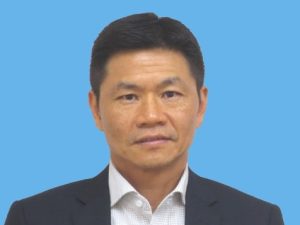 “Our key strategy is customer focus,” he explained in a recent interview with EMSNOW. “We differentiate ourselves by executing this strategy through our organizational structure. As we’ve grown from a $25 million to a $1 billion company, we’ve adapted by dividing our operations into Strategic Business Units (SBUs). Each SBU has its own people, factory, and is responsible for its own profit and loss. We’ve set criteria that each unit should not exceed $200 million in revenue and have no more than 10 active customers. This allows management to spend sufficient time focusing on customer needs. As the company grows, we will set up more SBUs.” LINK TO COMPLETE INTERVIEW.
This customer focus ethos permeates every business conversation within VTech CMS and for Andy being accessible to customers is of utmost importance. VTech CMS have never lost a customer due to performance or delivery issues, only when an OEM decides to bring manufacturing back in-house. They pride themselves on their ease of doing business, which is appreciated and rewarded by their customers.

The current SBUs are each focused on specific markets/technologies.
SBU1 – Professional Audio, IOT, Automotive, LED Lighting
SBU2 – Industrial, Professional Audio, Communications, LED Lighting, Home Appliance
 SBU3 – DJ Mixer, Professional Audio, Hearable
SBU4 – Professional Audio, Home Appliance, Power Management
SBU5 – Hearable, Professional Audio
SBU6 – Metal Factory
SBU8 – Medical, Professional Audio & Other (Mexico)
There is certainly an overlap of industry sectors served across the SBUs, the difference being the customers who are being served by the SBU.
As an existing SBU grows to more than $200M in revenue, another is spun off. This has been determined to be the optimum strategy.
GLOBAL FOOTPRINT
VTech CMS has a decidedly global manufacturing footprint and is considering expanding in that regard. Each facility has specific strengths and market sectors, while maintaining consistent quality and customer service standards matching those of the organization as a whole.
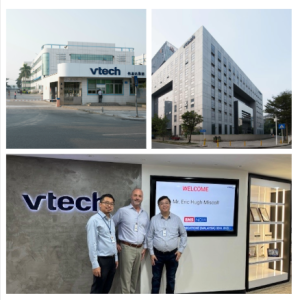
EMSNOW toured all of the global facilities and recorded podcasts that supplement the details about each location. A PDF with general information about each facility, as well as a link to the podcast can be downloaded from these links:
VTech CMS Corporate Profile
 VTech-CMS-China-Profile
China Podcast
VTech-CMS-Malaysia-Profile
Malaysia Podcast
VTech-CMS-Mexico-Profile
Mexico Podcast
VTech-CMS-NPI-Profile
NPI Center Podcast
VTech-CMS-Metal-Shop-Profile
EXECUTION ON INDUSTRY 4.0
Automating repetitive tasks and implementing smart manufacturing techniques is another VTech CMS competitive advantage. “About 20 years ago, when China started experiencing labor shortages, managers would tell me we couldn’t fulfill customer requirements due to labor issues,” Andy Leung explained. “I did not want to hear that, so I told them I would allow unlimited machinery investment. Don’t come back and tell me that you cannot do the job due to missing labor. Under one condition: the payback period must be within 5 years. In fact, most investments had a payback period of just 3 years.
“This helped us develop an automation culture,” he continued. “Since we’re a medium-mix, medium-volume manufacturer – unlike Tier 1 companies producing millions of a single product – we need some balance. Not everything can be fully automated.”
This is especially important with the tightening of the skilled labor pool all over the globe. VTech CMS’s focus is on three areas: digitalizing processes from the product level at all factories to gain the advantages of real-time data; using robotics to automate repetitive tasks, maintain consistent quality, and improve ergonomics; and implementing smart warehouse technologies to improve logistic efficiency and reduce return rates.
“To implement this (i4 strategy) we purchased a platform and employed consultants from a company spun off from Foxconn,” Andy said in the interview. ”We’re now in the final stages of implementation and starting to enjoy the benefits. Our teams are learning to use the platform to improve systems automatically, going beyond just displaying data.”
VTech CMS’s advanced manufacturing capabilities includes state-of-the-art SMT implementations, highly sophisticated finished products manufacturing, specialized clean room facilities, comprehensive testing and quality control systems, and metal working capabilities.
DESIGN ENGINEERING PROWESS IN KEY MARKETS
Vtech CMS’s manufacturing strength can be traced to its history in high volume integrated manufacturing. Their NPI Center in China operates at the center of the Shenzhen cluster of universities, new product incubators, and supplier ecosystem ensuring a vibrant, innovative community for ‘new product realization.’ The center focuses on meeting customers where they are in the product development cycle, enabling customers to leverage VTech CMS’s extensive EMS and ODM services, especially around professional audio and IoT applications. Particularly impressive were the many certifications in both production and design, including medical and automotive.
INDUSTRY SECTORS SERVED
VTech CMS serves diverse industries with specialized manufacturing solutions:
-
- Professional Audio (44.9%)
- Hearables (17.7%)
- Industrial Products (11.1%)
- Medical Devices (9.3%)
- IoT & Communications (5.7%)
- Home Appliances (4.4%)
THE FUTURE LOOKS BRIGHT
In summary, the company maintains its competitive edge through:
-
- Lean corporate management structure
- Ease of doing business due to customer service ethos
- Expanding global footprint
- Dedicated NPI (New Product Introduction) Centre
- Deep implementation of Industry 4.0
- Strategic use of automation
To sum up, my impression is that VTech CMS excels at providing the highest level of manufacturing services focusing on innovative products for a variety of high-tech markets. It is a company that has flown under the radar of most EMS watchers throughout the past several decades, but that is about to change as the global geopolitical landscape shifts once again.
VTech CMS is well positioned for growth in advanced manufacturing
ADDITIONAL THOUGHTS ON HONG KONG
Many people in the West tend to conflate Hong Kong and China, which is technically true from a geopolitical perspective, but not so much from a commercial or operational perspective.
- I was not required to have a Visa to enter Hong Kong, but I did need one to enter China.
- There is a clear border separating Hong Kong and China with Customs checkpoint that we had to clear both when entering and departing China.
- Hong Kong maintains its own currency separate from the Chinese Renminbi that is tied to the US dollar.
A comparison of Hong Kong to Singapore seems instructive. Both cities boast world-class infrastructure, including advanced transportation networks, sophisticated telecommunications, and efficient ports that facilitate international trade. Their financial systems are remarkably similar, built on robust banking sectors, sophisticated capital markets, and growing fintech capabilities. Both jurisdictions operate under British-derived common law systems, ensuring strong rule of law, intellectual property protection, and efficient dispute resolution mechanisms. The business environment in both cities is distinctly international, with English serving as the primary business language and both hosting substantial expatriate communities. Their tax systems are notably similar, featuring low rates, simple structures, and numerous advantages for international businesses.
Both cities pride themselves on highly educated, multilingual workforces with strong international business acumen. Their strategic locations serve as gateways to broader Asian markets, supported by extensive free trade agreements and strong diplomatic relationships.
These parallel characteristics have enabled both cities to maintain their positions as leading international business centers, despite their relatively small geographic size.
A FINAL PERSONAL REFLECTION
It had been almost 20 years since I was last in Hong Kong, and I was impressed by how much it had developed and modernized yet still felt familiar. There were many more modern structures, yet it was still the same bustling metropolis with people from all over the world going about their business. And that view of Hong Kong Island from the Kowloon side is still spectacular!

I was glad to see that the iconic Star Ferry system was still in operation. In fact, I don’t think those have changed at all over the last many decades.

Lastly, I was also glad to discover that the old bar I used to frequent in my younger days was still there. Tucked in a side street behind the Peninsula Hotel, Ned Kelly’s Last Stand was always frequented by ex-pats and boasted a Dixieland band. Ned Kelly was the Jesse James of Australia. I did stop in and have a pint (or two) and recall a few fond memories.