




Scaling Ultrapure Water Technology for 2030 Growth
By Malek Salamor, SVP and General Manager, Ovivo Ultra-pure Water+ by Ecolab

As the microelectronics industry races toward a one trillion dollar revenue milestone by 2030, two facts are impossible to ignore: semiconductor manufacturers face increasingly complex water requirements; and the energy used to power both utility and production process is itself water dependent. The result is a classic water–energy nexus: choices about water sourcing, reuse, and purification directly affect energy consumption, throughput and, ultimately, yield.
For executives and planners, this reality is not a theoretical sustainability conversation; it is a commercial one. Meeting aggressive capacity and revenue goals while avoiding the operational and permitting risks of water shortage will require pragmatic investments in ultrapure water (UPW) systems, new reuse architectures, and real-time monitoring that make high-recovery reuse technically feasible and commercially viable.
Why ultrapure water matters differently today
Ultrapure water is not a utility in the same sense as chilled water or compressed air; it is a critical resource for process operations. At modern node sizes, trace ions, particles, or organics can cause wafer defects at the most microscopic levels. As technology advances and semiconductor manufacturers shrink feature sizes, high purity water remains non-negotiable. Yet in parallel, semiconductor manufacturers are scaling throughput to meet demand, increasing the total volume of ultrapure water required.
This combination – tighter specs and higher volumes – shifts ultrapure water from a site engineering problem into a strategic capacity constraint. Planning teams must account for quantity and quality, addressing questions around a fab’s ability to supply enough water and sustain ultra-low contaminants over decades of operation. The answers influence site selection, capex, and long-term operating risk.
Water recycling and reuse must be scaled to support growth
Given the twin pressures of water stress and growing demand, water reuse is increasingly the practical path forward. Advanced purification technology can help semiconductor manufacturers reclaim significant water for reuse in non-process utilities, or, with additional polishing, for certain process applications. The commercial case is straightforward: investment in recycling and reuse help semiconductor manufacturers reduce the amount of freshwater required so they can scale to meet growing demand. The technical case is more nuanced: water reuse requires robust pre-treatment to remove contaminants and semiconductor manufacturers need to conduct significant validation to preserve consistent product quality.
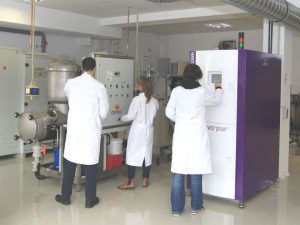 Recent innovation trends support ultrapure water management at scale. First, continuous monitoring and analytics help semiconductor manufacturers assess and validate key water system performance indicators in real-time. By keeping a pulse on critical ultrapure water contaminants, like urea and trihalomethanes, operators can maintain consistent water quality and preserve process continuity. Second, advances in polishing and pumps, such as metal-free systems that preserve high ultrapure water flows and purity standards, allow semiconductor manufacturers to mitigate contaminants, like conductive particles, in process streams. This limits additional removal steps to address particles introduced from maintenance. Third, advances in membranes, ion exchange media and fouling-resistant components help address increasingly microscopic contaminants and extend production windows, minimizing maintenance downtime and operational costs. Yet to apply these technologies effectively for water recycling and reuse, semiconductor manufacturers need an integrated strategy that considers both water and energy as a part of the equation.
How the water–energy tradeoffs play out in practice
With the industry expected to grow by 6-8% every year through 2030, microelectronics water requirements will scale accordingly. To offset water use, some semiconductor manufacturers turn to air-cooled technologies as an alternative, but air-cooling requires substantial energy and transfers heat less efficiently than water – both significant trade-offs. For microelectronics executives, the right decision depends on local grid factors, climate, cost of water, and process sensitivities. Industry decision makers can take several practical steps to address water and energy needs early:
1. Treat ultrapure water capacity and water reuse as a capital and programmatic item on par with cleanroom design and raw materials logistics. Early decisions on water sourcing materially affect build timelines and permitting.
2. Run a site-level water and energy audit. Map freshwater availability, alternative non-potable sources, wastewater discharge constraints, and the energy intensity of candidate power supplies. Use that map to identify where reuse yields the most value.
3. Require auditable, real-time controls. Deploy advanced monitoring systems, sensors and analytics that provide actionable alarms — not just raw data. Auditable telemetry both protects yield and simplifies regulatory reporting or permit negotiations.
4. Partner across the value chain. Utilities, equipment providers and system integrators must be involved early. Permitting, wastewater handling and community engagement are often the gating factors for reuse projects.
What success looks like
Organizations that pair proven ultrapure water engineering with continuous monitoring and a disciplined service program will be able to reduce freshwater withdrawal while protecting yield – a necessary tradeoff for many regions that will host the next generation of fabs. This combination converts water risk into a managed utility, which can be validated and scaled. In doing so, the industry can meet commercial objectives while reducing regional stresses, creating a practical path towards growth and sustainability.