



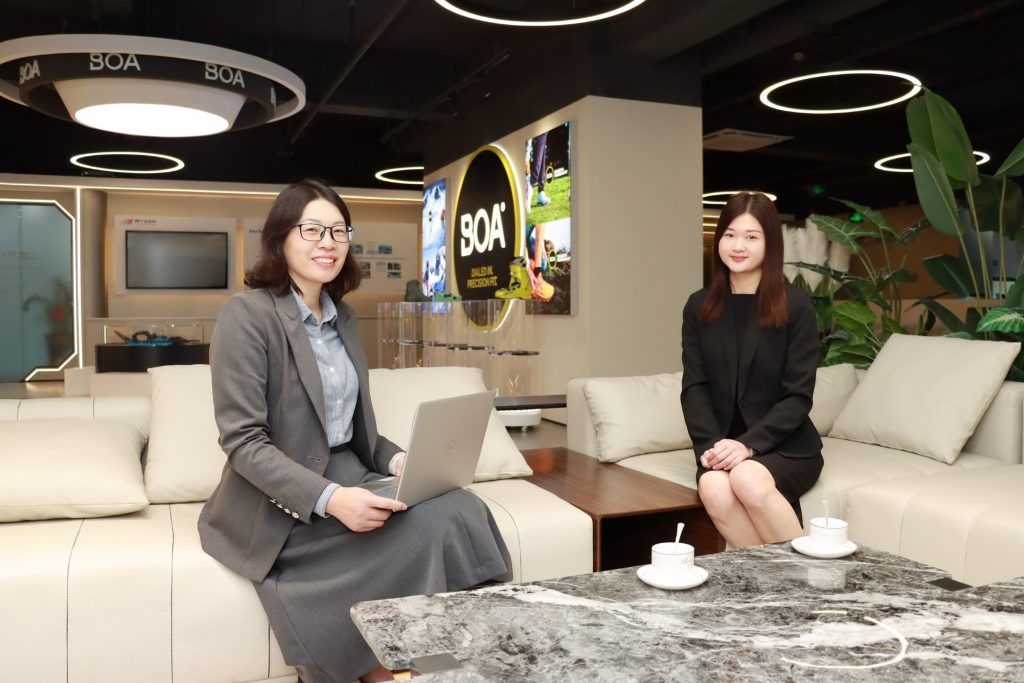
In the highly complex world of precision manufacturing, the conversation often focuses on technical specifications, automation and logistical efficiency. However, as the industry marks International Women’s Day, a distinct partnership between Ryder Industries and BOA Technology offers an additional dimension.
Source: Ryder Industries & BOA
As technology evolution accelerates, perhaps the most critical machinery in a modern supply chain is human connection. In a meritocratic culture, built on mutual trust, both Ryder and BOA have seen female leadership thrive – and as a result, their shared operations have gained efficiency and effectiveness.
Partnership as a Strategic Advantage
 For over two decades, Ryder (a premium EMS provider) and BOA (creator of performance fit system) have operated a model that blurs the lines between customer and supplier. Their collaboration provides a blueprint for how ‘embedded teams’ can improve on the effectiveness of traditional hierarchies – and create legitimate pathways for women in the manufacturing sector.
In complex production environments, rigid corporate protocols can hinder responsiveness. As Stephen M.R. Covey writes in The Speed of Trust, nothing accelerates performance like trust. This principle is reflected in Ryder’s relationship with BOA. As divisional vice president and senior leader in the BOA relationship, Dongfang Ding explains that the real strategic advantage lies in enabling faster decisions, clearer communication and more agile execution.
 “As a team, we operate on a basis that is closer to friendship – bringing immediate access and meaning we do not need to wait for formal appointments to resolve critical issues. If we identify an opportunity or a challenge, we always work together – quickly,” DingDong explains.
This fluidity allows the teams to pivot instantly from daily operations to high-level strategic problem-solving. It transforms the relationship from one of checking boxes to one of shared risk and rapid execution, a necessity when managing complex supply chains across the US, China and Vietnam.
Valuing a Broader Range of Skills
Historically, manufacturing leadership was often defined strictly by technical capabilities – and the ability to deliver on outcomes in tooling, engineering and volume metrics. While these remain foundational – and both parties treat this as ‘the base case’ – the Ryder-BOA partnership has thrived by placing equal value on a wider range of skills: communication, empathy and influence.
Sunny Gao, director of Manufacturing Excellence at BOA, notes that in their shared environment, “traditional hierarchy and authority” are not prioritised above “influence built on expertise” and “collaborations”. This principle has been particularly beneficial for female professionals. While some technical disciplines have historically been male-dominated, roles focused on efficiency, strategy and improvement are seeing a far more balanced gender representation, effectively challenging traditional barriers and helping to remove the glass ceiling.
By valuing strategic contribution and tangible results over job titles, the partnership creates a meritocracy where diverse talents can thrive. This culture encourages team members to look beyond their silo, fostering what Sunny describes as “cross-functional transparency,” where resources and support are visible to everyone.
Shared Mentorship: A “Win-Win” Mindset
This depth of collaboration extends into talent development, creating a unique ecosystem for professional growth. The companies practice a form of “shared mentorship” where boundaries between the organisations blur.
Leaders from BOA actively encourage their teams to seek mentorship from Ryder’s senior leadership, and vice versa. “We are not only focused on one party’s success,” Sunny explains. “Instead, we emphasise a win-win mindset, where the goal is to build collective team capability.”
This approach provides junior female professionals with expanded visibility. Emerging leaders are intentionally brought into critical cross-functional meetings and encouraged to facilitate discussions, ensuring they are seen and heard by stakeholders across the entire supply chain. It is a strategy designed to build confidence and readiness, ensuring that when opportunities arise, the talent pipeline is prepared to step up.
The Human Element in an AI Future
Looking forward, the leadership team is already embracing Industry 4.0, automation and AI. But as Rita Li, director of Supply Chain at BOA, observes: “the human element – specifically the trust built through deep partnership – will become more, not less, important.”
Rita points out that while data can handle routine duties and “raise the flag” on risks, it can not execute the complex recovery plans required in real-world manufacturing. “Data can guide us,” she notes, “but trust comes from consistent engagement and honest communication. This is what turns insight into strategy”.
Advice for the Next Generation
For young women entering the manufacturing sector, the advice from this leadership team is grounded in the practical realities of their success: preparation and self-belief.
“Get yourself prepared and ready to take up any upcoming opportunity,” Rita states.
“Own your voice. Believe in yourself. Never let others limit your potential.” says DingDong.
“Always be confident and always be fair.” concludes Sunny.
Ultimately, the Ryder and BOA story illustrates that while precision machinery drives production, it is the precision of the partnership – built on trust, access and mutual respect – that drives success.
Ryder Industries is a Swiss-founded Electronics Manufacturing Services (EMS) provider with more than 45 years of experience partnering with leading global brands to design, develop and manufacture high-performance electronic products. Strengthened by decades of operating in Asia, the company combines Swiss engineering precision with the resilience, industriousness and collaborative culture embedded in its Asian operations. Its capabilities span engineering design, prototyping, SMT, precision plastic injection moulding, final assembly and quality optimisation, delivered through advanced manufacturing facilities in China and Vietnam.