


Uncertainties around tariffs is reshaping global trade flows, forcing container logistics players to rethink sourcing strategies and market access. A recent Container xChange survey (January 2025) revealed that 81% of container logistics businesses are actively building new partnerships beyond traditional trade routes. However, 78% of respondents struggle to establish reliable partnerships due to increasing geopolitical risks and supply chain disruptions. These findings come at a time when the Trump administration has imposed fresh tariffs on Mexico, Canada, and China, leading to retaliatory measures that further disrupt global supply chains.
Understanding the New Tariffs and Countermeasures: What Container Traders Need to Know
The U.S. imposed a 25% tariff on all non-energy imports from Canada and Mexico, along with a 10% tariff on Canadian energy imports (mainly crude oil). Chinese imports face an additional 10% tariff, compounding existing duties. However, The United States paused its planned tariffs on Canada and Mexico for 30 days. Retaliatory responses include: Canada: $20 billion in tariffs on U.S. goods, with a second round of $85 billion in 25% tariffs set to take effect in three weeks. Mexico: Announced retaliatory tariffs (details pending). China: Vowed countermeasures via its Ministry of Commerce.
“The trade war is set to intensify in 2025, creating major challenges for global supply chains,” said Christian Roeloffs, co-founder and CEO of Container xChange. “A key consequence will be rising shipping costs and transit times, which will particularly strain smaller container trading and leasing businesses. In the short term, leasing companies may see higher profits, but in the long run, increased costs will trickle down to consumers, dampening demand. Strategic partnerships across multiple geographies are now critical for businesses to remain resilient against mounting trade, economic, and demand pressures.”
Shifts in Container Demand: Frontloading & Long-Term Risks
Historically, trade uncertainty has led to frontloading, where importers rush shipments ahead of new tariffs. This trend has sustained demand through H2 2024 and into early 2025. Short-term: U.S. importers are expected to frontload cargo until the tariffs are fully enforced. Long-term: Demand contraction remains a risk as higher costs curb consumer spending and accelerate supply chain diversification efforts. Potential EU tariffs in response to U.S. policies could further disrupt East-West container flows, driving European suppliers to explore alternative markets.
The Role of Strategic Partnerships in 2025
As President Trump shoots new tariff measures, nations are likely to take pre-emptive steps to build resilience against potential economic disruptions. This could lead to the formation of strategic alliances among countries facing common threats from U.S. tariffs. Such partnerships could trigger collective strategies to counterbalance the impact of tariffs and strengthen their trade networks in an increasingly polarized global economy. If nations form alliances to bypass or mitigate U.S. tariffs, container logistics businesses may see shifts in trade routes. For example, increased regional collaboration could lead to greater reliance on non-U.S. markets, creating new opportunities along emerging trade lanes (e.g., intra-Asia or South-South trade). Businesses will need to adapt quickly to changing trade patterns. Flexibility in container positioning, supply chain networks, and partnerships with local operators will be critical to capturing these shifts. Container logistics businesses could benefit from partnering with shipping lines, ports, and other stakeholders in allied countries. Such partnerships may offer advantages like cost-sharing, streamlined customs processes, or better access to growing markets.
Container Pricing Trends: A Strong Start to 2025
The average prices for second hand containers remained strong through the H2 of 2024 and further into the beginning of 2025. Currently, average container prices are at higher levels than the last year.
Inflated container prices in Asia
On a month-on-month basis, average container prices have declined marginally over the last 30 days across Asia, North America, Middle East and ISC and Europe as on 4 February 2025. Latin America West and Japan & Korea were the only regions that recorded significant positive change in average prices for 40 ft high cube cargo worthy containers. 30 days percentage change in average container prices as on 4 February 2025
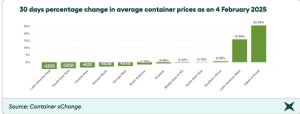
Container price movements have remained relatively stable, with changes limited to a narrow range of -4% to +0.59%. This indicates that while market perceptions may be fluctuating, the underlying price adjustments have been minimal. On a year-on-year basis, Asia recorded a significant increase in average container prices in February 2025. Average of yoy percentage change in container prices (February 2024–25)
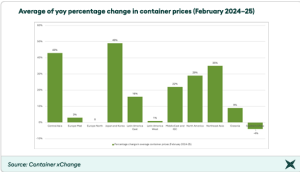
In Asia, average container prices jumped by 82% year on year in February 2025 in Vietnam. These were $1310 in February 2024 and stand at $2390 in February 2025 (as of 7 February 2025). Other locations like India, Middle East, Taiwan (72%), Thailand, Malaysia, registering more than 50% hike in these prices.
“Asia has outpaced other regions in terms of average price rise over the past year, with key growth hotspots like India, Vietnam, Thailand, Malaysia, and Dubai standing out. The consistent upward trajectory in container prices reflects a dynamic shift in these markets, driven by growing demand and a noticeable increase in container trading and leasing activities. As tariffs and trade tensions push suppliers and manufacturers to reconfigure their supply chains, these regions will continue to rise in importance. We expect container prices in these areas to remain stable, and in some cases, the intensifying trade wars will only further solidify their critical role in global trade.” shared Christian Roeloffs. “As U.S. buyers look beyond Mexico and Canada for imports, there could be increased demand for alternative suppliers in Asia, South America, and Europe, reshaping traditional container routes.” Roeloffs added.
Container Price Expectations simmer
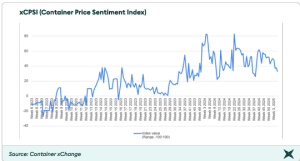
Starting the third week of 2025, xCPSI (Container Price Sentiment Index) started to deteriorate week by week from 50 points in week 2 to 33 in week 5. The index readings have been deteriorating since the end of September in 2024 until 1 February 2025. The xCPSI readings were at an average of 73 points last year (2024) in the month of January. The data also suggests heightened volatility, with sharper and more frequent shifts in the index—a reflection of growing market uncertainty and nervousness among container logistics market participants.
Market participants expect market correction as supply exceeds demand in 2025
Following a period of inflated container prices driven by supply chain disruptions and pulling forward of orders causing temporary demand, the market is now entering a phase of natural correction. Traders are recalibrating their expectations, recognizing that the container market has likely reached its peak and is stabilizing at a more sustainable level. A key factor contributing to this shift is the anticipated inventory surplus in 2025, with supply set to outpace demand, further influencing market dynamics.
What to Expect in 2025?
“The tariff war will force U.S. businesses to reconsider sourcing strategies, potentially leading to increased reliance on alternative suppliers in Asia and Europe in the near term. More sourcing locations mean longer supply chains, increased lead times, and higher logistics costs, requiring businesses to rethink inventory management. Countries with free trade agreements with the U.S., could see higher transshipment volumes as companies route goods indirectly to avoid tariffs. With sourcing diversification, secondary ports and intermodal logistics (rail/trucking) could see increased demand.” shared Roeloffs. “Reduced trade with certain regions may cause equipment imbalance (empty containers in one region, shortages in another). Shipping lines may reduce capacity or introduce surcharges to offset rising costs, further risking supply chain stability.” added Roeloffs. “Higher tariffs will translate to increased consumer prices, putting pressure on businesses to absorb costs or pass them on. Leasing rates and repo dynamics will potentially shift based on new and emerging trade patterns.” concluded Roeloffs.
In 2025, container traders must brace for continued volatility fueled by trade wars, shifting demand patterns, and evolving supply chain strategies. The impact of tariffs will not only reshape traditional trade routes but also drive-up costs, affecting container availability and pricing. Strategic partnerships will be instrumental in mitigating risks, ensuring market access, and maintaining operational resilience. With heightened uncertainty, container traders should prioritize flexibility, diversify sourcing strategies, and stay attuned to policy shifts that could redefine the global logistics landscape. For similar analysis, reports and commentaries, and to keep yourself updated about the macro events impacting the container logistics industry, visit Container xChange Market Intelligence Hub.