



You can’t prepare for a storm if you don’t know it’s coming. Today’s labor market rests on baseline assumptions that were formed when the Baby Boomers dominated the workforce, but now, this enormous cohort of 76 million Americans is ready to retire—and the US faces a shortfall of millions of workers in the decade to come. This summary of a report from Lightcast outlines the problem and solutions.
Workforce strategies need to adapt, but if you don’t know what changes lie in store, you can’t know what changes to make in response. The disruption ahead is like a hurricane: We can use the conditions that formed it to understand the path it will take, we can see the outer bands that have already begun to hit certain areas, we can predict when it will make landfall, and we can recognize that those in the direct path of the storm need to make different preparations than those further out. The Rising Storm outlines all of these.
Some findings are familiar territory for Lightcast, because this report is part of the ongoing Demographic Drought series of research, but the changes are significant. While past reports were only able to say there was disruption ahead, the patterns are clearer in The Rising Storm, providing insight on when the storm will arrive.
Inform, Don’t Alarm
The news is not comforting—the most acute shortages of workers will arrive in under a decade, primarily in the next five years, and the industries hardest hit are among those our society relies on most, including healthcare and construction. However, that’s not to say this report is all doom and gloom. It was written with two goals: Inform, Don’t Alarm
The need for this research arose because not enough people understand how severe the coming storm will be. After all, people have always retired, and society has always gotten along just fine, so why are the Baby Boomers any different? It’s a question worth asking (and the answers are in Chapter 2). In fact, even government statistics agencies fail to recognize the implications of their own predictions, and it is only by analyzing them together that the full picture becomes clear.
The danger ahead comes from a perfect storm of factors all coinciding before the end of the decade, and therefore relies on several different patterns, including retirement ages, AI, immigration, birth rates, and even addiction and incarceration. If someone wanted to argue against a worker shortage ahead, it would be by setting one of those patterns against the others—perhaps by saying that our older population will find workers in older adults who want to put off retirement. But in fact, retirements are actually happening earlier and earlier, and all the data points in the same direction: there’s a storm coming.
Anticipate and Adapt
The purpose of spending so much time on the background of the disruption ahead is to prepare for it as well as possible. If we don’t understand why certain shortages are happening, then we won’t know how to respond effectively— the solution has to match the problem. One size does not fit all: Worker shortages can be solved by developing local workforces, globalization, automation, and immigration, and each industry will have to create its own balance between those four options in order to meet its own specific needs.
The report is structured like the path of a hurricane, starting with the conditions forming, the first gusts, and then landfall. Chapter 1 covers the Baby Boomers’ labor market, and how their unique economic situation led to beliefs that were perfectly valid at the time, but no longer match our economic reality. In short: the Boomers’ world was full of competition, and their focus was keeping other workers out. Now, in a market defined by worker scarcity, we need to look for ways to let workers in.
Chapter 2 covers the present and recent past as Boomers have retired—out of the 5 million workers who have left the labor force since 2020, 80% are over the age of 55, and Boomers are the second smallest generation currently working. Unlike their grandparents, younger generations are starting work later and finding careers in office-based jobs that require a college degree, and food service, the skilled trades, and others of the most critical industries in the US are already feeling the strain. This has led to understaffing and shortage challenges that foreshadow what we’ll see in the future, as US population growth will outpace labor force growth by nearly 8 to 1.
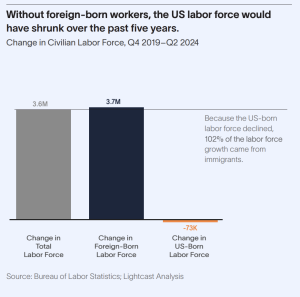
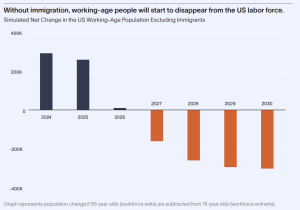
Chapter 3 covers landfall and the decade to come. Job posting data shows high demand across many critical industries, already greater than the number of workers the US is projected to gain in the coming years. The US working-age population is expected to grow by 18.7 million by 2032, but labor force participation is expected to drop from about 62.5% currently to 60.4%; in other words, the US will have more people, but a lower share of them will be working. Compared to the present day, that’s a deficit of roughly 6 million workers. Immigration will be key to keeping the economy afloat, and in fact already is: All growth in the labor force since 2019 can be attributed to foreign-born workers.
Chapter 4 covers solutions. Some industries, like healthcare, will feel the full Category 5 force of the storm to come. Others, like tech, will feel less of the impact. But the hurricane will hit shore, and there are steps every organization can take to prepare.
Included in this overview are case studies and other examples of solutions available to build a future-ready workforce. So far, the labor market of the 2020s has seen unprecedented turbulence. The overheated pressure of 2022 and 2023, which created record highs in job openings and quits, leading to supply chain shortages and inflation, was not a one-time blip; instead, it was a precursor (an “outer band”) of what’s to come. As those trends have eased, it would be tempting to think that the worst is behind us, when in fact, the worst is still to come. Right now, we’re in the calm before the storm, which means now is also the time to prepare for what’s ahead. And that starts by understanding where we are and how we got there.