



The Way We See It: Navigating Industry Transitions Through AI, Reshoring, and Economic Uncertainty
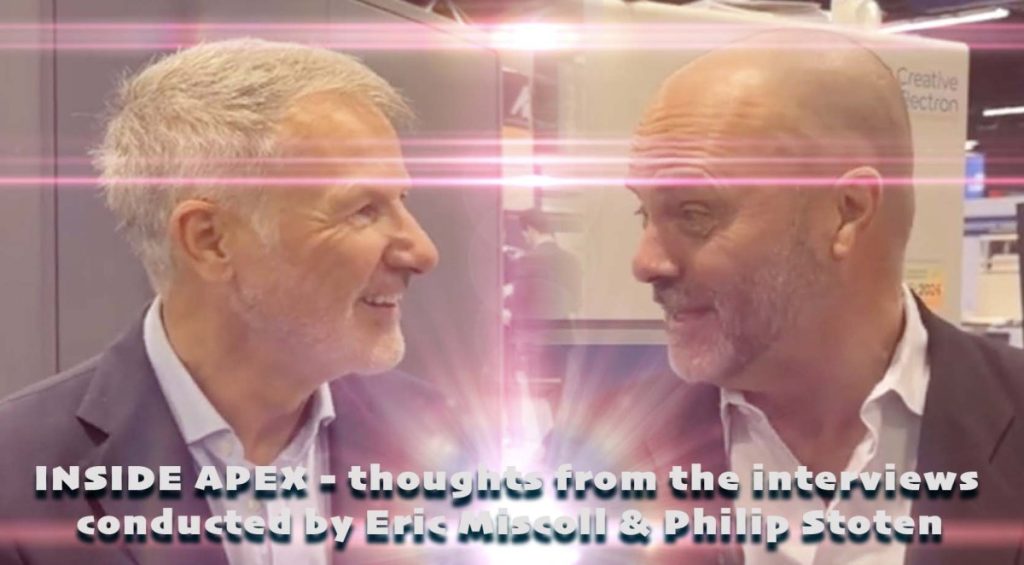
By Philip Stoten and Eric Miscoll
APEX 2025 showcased an industry in transition, with decent attendance and some optimism despite ongoing economic and trade uncertainties. In our daily wrap-up discussions, we welcomed the leaders of the two companies that hosted our studio for the week, Koh Young’s Joel Scutchfield and Creative Electron’s Dr. Bill Cardoso. These in depth but informal conversations at the end of each day revealed key themes dominating conversations on the show floor: AI implementation, reshoring initiatives, talent challenges, and strategies for navigating market volatility.
AI Adoption Reaches Critical Mass
After years of theoretical discussions, artificial intelligence implementation has become an immediate priority for electronics manufacturers. Many companies sent additional staff specifically to investigate AI applications, wanting to avoid repeating mistakes made during the Industry 4.0 transition.
“I think what people are trying to figure out is how not to get drowned by the wave once it hits them, because then it’s too late,” observed Dr. Bill Cardoso, CEO of Creative Electron. “It’s that reconnaissance mission to figure out what to do now before they get left behind.”
Cardoso noted the convergence of affordability and capability in AI-powered inspection systems, creating a technological inflection point. “We’re reaching a point where the technology and affordability of these machines are reaching the point where you’re about to break the cusp,” he explained.
For many manufacturers, the challenge lies in developing focused, manageable AI initiatives rather than sprawling, undefined projects.
“A lot of EMS companies want the project corralled. They want a small, tangible AI project they can cut their teeth on, where they know what the KPIs are, they know what the return of investment is, they know what success looks like,” noted Philip during the day two wrap-up.
The industry is also wrestling with data security considerations as companies decide whether to leverage larger AI models or develop proprietary solutions. “There’s definitely the risk of having your data dumped into this large model that’s going to be used by your competitors,” Cardoso explained.
Reshoring Momentum Accelerates
Recent trade tensions and tariff uncertainties have accelerated the trend toward regionalized manufacturing, with many companies actively relocating production from China.
“There is a directive, a mandate for certain customers, certain manufacturers, to get out of China,” reported Joel Scutchfield, General Manager of Koh Young America. “That’s real, and so that will certainly bring back [manufacturing] somewhere, whether it’s here, whether it’s Mexico, whether it’s India, or other parts of Southeast Asia.”
The mid-sized EMS sector ($50-200 million) appears especially well-positioned to capitalize on this reshoring trend. “They seem to be the best position to take on that kind of work,” Scutchfield observed. “I talked to a couple of folks just in the last two hours that are looking at a significant amount of work coming back from China that they’re positioned to be able to take without mass expansion and brick and mortar.”
Eric advocated for an in-region-for-region manufacturing approach: “It makes sense if you’re consuming it here, with all the concern about supply chains and sustainability…”
Navigating Market Uncertainty
Despite strong activity at the show, companies continue to wrestle with market uncertainties relating to economic conditions, tariffs, and global trade policies.
“One of the big things is still the uncertainty in the market. We’re in transition,” Eric noted. “Everybody’s talking about: When is this going to be over? Everybody seems to give it a few months to settle down.”
Tariff uncertainties are creating particular challenges for cross-border manufacturing operations in North America. Companies with manufacturing facilities across multiple geographies hold an advantage in this environment.
“Having manufacturing plants in different geographies allows you to shift things around,” explained Cardoso. “You become a global company that can meet the demands of the customers where they are, when and how they need it, so that we can actually use tariffs as an advantage. Uncertainty becomes an advantage, not necessarily a hindrance.”
The Talent Challenge
The industry continues to struggle with talent acquisition and retention, with participants noting a generational gap in the workforce.
“It’s almost like we skipped a generation,” observed Philip. “There seems to be quite a few 20-somethings around and low 30-somethings. There are plenty of 50-somethings and even more 60-somethings, but we just seem to have missed that middle piece.”
While acknowledging the challenge, Scutchfield shared encouraging signs from his company’s sales channel: “We had our sales channels team, our reps team, who are all younger, again ready to go, excited. I think that’s great.”
Automation and software solutions are helping address some talent challenges by systematizing previously expertise-dependent processes. As Eric noted: “Quoting, especially in an EMS company, that was a closely held secret how they did that. Now we have quoting software which is ubiquitous in the industry.”
Show Activity Reflects Cautious Optimism
Despite uncertainties, show attendance was strong, with high-quality engagement reported by exhibitors.
“We’re already over 200 scans,” Scutchfield reported at the end of day one, adding that there was “a good amount of near-term real activity.” He observed that many companies have adopted a pragmatic approach to the current environment: “These are people that have basically said, you know, it’s going to be what it’s going to be. Let’s go, let’s get on with it.”
In the US market particularly, many segments are performing well despite broader economic concerns. “Demand is strong in that middle tier, like $50 million to $200 million,” noted Philip. “That’s a sweet spot to be in as a contract manufacturer right now, especially if you’ve got a proportion of your business in defense…”
Looking Ahead
One of the few pieces of breaking news from the show was a joint venture announcement between Creative Electron and Unicom, highlighting the industry’s ongoing consolidation and strategic partnership formation.
As APEX 2025 concluded, the electronics manufacturing sector demonstrated resilience and adaptability in the face of multiple simultaneous transitions – from AI implementation and reshoring initiatives to talent evolution and economic variability. The industry appears poised to navigate these challenges through strategic agility, regional manufacturing approaches, and focused technology adoption.
Philip Stoten is a technology journalist specializing in electronics manufacturing. Eric Miscoll is the Publisher of EMSNOW.
You can watch these two informal wrap ups along with many other interviews from the show, including Eric interviewing Bill and Philip interviewing Joel on the SCOOP YouTube channel