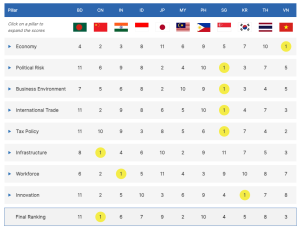


 The Asia Manufacturing Index (AMI) enters its 3rd edition at a time when Asia has firmly established itself as the world’s manufacturing hub. Companies across industries continue to rely on Asian locations for both high volume and high value production. The AMI 2026 captures the relative competitiveness of 11 major Asian manufacturing economies across 8 key pillars and 43 sub-parameters. This edition provides a structured and transparent benchmark designed to support fact driven comparisons at a time when manufacturing decisions have become increasingly complex. The AMI is also a core component of our APAC manufacturing market research work, created to help investors navigate the region more efficiently.
The AMI is published at the nexus between year end and the beginning of the new year. It represents a snapshot in time, based on the most recent data available. Policies, financial shocks, regulatory changes, and new supply chain incentives can occur in real time and may shift the landscape rapidly. Nevertheless, the AMI 2026 offers a strong foundation for assessing competitiveness and identifying the most relevant manufacturing locations.
China remains the number one ranked manufacturing country for the third consecutive year, supported by its extensive industrial ecosystem. The most significant shift in this edition is Malaysia’s rise to second place, its first time entering the top two. Vietnam, which previously held the second position, now ranks third. These movements reflect intensifying regional competition rather than declining fundamentals. Singapore climbs into fourth place, Thailand rises from tenth to eighth, and Japan, the Philippines, and South Korea each adjust modestly. India remains stable at sixth and Indonesia remains stable at seventh, reflecting consistent policy direction and steady long term industrial development. Bangladesh remains in eleventh place.
INDIA Overview – India faces a unique duality: a massive market and strong policy momentum combined with structural bottlenecks in infrastructure, logistics, and administrative complexity. Its sixth-place ranking reflects strong economic fundamentals but also long-standing challenges that continue to affect manufacturing competitiveness. India’s strengths include large-scale labor availability, fast-growing domestic consumption, and active industrial policies such as the Production Linked Incentive (PLI) scheme, which targets electronics, pharmaceuticals, solar energy, and automotive components.
Infrastructure constraints remain a central concern. While progress has been made under programs such as Bharatmala, Sagarmala, and the Dedicated Freight Corridors, logistics efficiency still trails leading ASEAN peers. Port congestion, multimodal connectivity gaps, and uneven utilities quality continue to affect operating conditions. Reforms are underway, but time will be required before India’s infrastructure reaches regional best-practice levels.
Governance and regulatory reforms have improved ease of doing business, particularly in areas such as taxation and insolvency. However, administrative processes can remain slow or inconsistent across states. India offers competitive labor costs, but skill levels vary widely, and firms often need to invest heavily in in-house training.
Despite these challenges, India’s medium-term outlook is strong. Favorable demographics, market scale, digital reform momentum, and significant FDI inflows into manufacturing position India as a growing alternative manufacturing hub for global companies seeking diversification.
SOURCE: