



 |
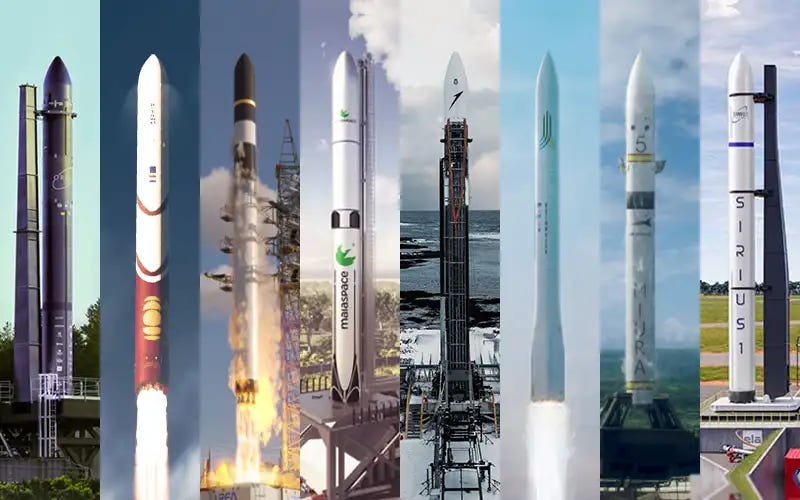
Credit: Orbex / Latitude / Rocket Factory Augsburg / MaiaSpace / Isar Aerospace / Simon Fischer – Wingmen Media / HyImpulse / PLD Space / Sirius Space Services
On 30 March 2025, Isar Aerospace made an inaugural attempt to launch its two-stage Spectrum rocket from Norway’s Andøya Spaceport. Although the rocket successfully cleared the pad, its vector control system appeared to begin overcorrecting following the flight’s pitch-over manoeuvre. Around 30 seconds after liftoff, the flight termination system shut down all nine first-stage engines, sending the rocket plummeting into the sea below, where it exploded on impact a short distance from the launch site.
Following the failed debut, two videos showing the spectacular final moments of the Spectrum rocket were released by NSF, Isar Aerospace’s streaming partner, and launch site operator Andøya Space. Commenting on one of the clips, former ArianeGroup CEO Alain Charmeau offered what can only be described as pointed criticism of Europe’s small launcher efforts to date.
“In 7 years, nearly 2 billion Euros have been committed in Europe to develop a small launcher, still without the slightest success. What a waste,” Charmeau wrote.
While short, Charmeau manages to pack several inaccuracies into his commentary. Firstly, he has overstated the total investment in European launch startups by about €900 million. Of the approximately €1.1 billion invested to date, Isar Aerospace alone accounts for over €400 million. With such a significant share of the total capital, it’s little surprise that Isar was the first of its peers to attempt an orbital launch, seven years after its founding. And yes, at first glance, taking seven years to conduct an unsuccessful first flight appears slow, especially when compared to market leader SpaceX, which made its first launch attempt just four years after being founded. But Isar’s trajectory is not unusual.
Rocket Lab, for instance, was founded in 2006 and didn’t launch its first Electron rocket until 2017. Its first successful flight would only come a year later. Firefly Aerospace launched its first Alpha rocket in 2021 after being founded in 2017. However, the company wouldn’t manage a successful first launch until September 2023. Relativity Space was founded in 2015 and wouldn’t launch its first rocket until March 2023, which ultimately failed. The company has yet to complete a successful flight despite raising $1.34 billion in funding, more than all European launch startups put together. It’s also important to note that US launch companies have enjoyed institutional support. Rocket Lab, for instance, launched a NASA mission on its fourth flight. Firefly Aerospace topped that with NASA booking space on the company’s second flight. To say that European launch startups have been particularly slow isn’t entirely inaccurate, but it ignores broader market conditions and is, at best, misleading.
As for the remaining €700 million raised by European launch startups thus far, it’s spread across about a dozen companies. Besides Isar Aerospace, only Orbex, PLD Space, and MaiaSpace have surpassed the €100 million mark. Both Orbex and PLD Space have also been active for more than seven years. Meanwhile, Rocket Factory Augsburg (RFA) came painfully close to an inaugural launch attempt despite having secured less than €70 million. The company is now working towards returning to the pad for another shot.
While Charmeau’s attempt to suggest that Europe has invested heavily in small launchers with little return at first appears compelling, the reality is, as it often is, much more complicated. One would think that someone who served as CEO of the largest European rocket builder would have a better grasp of this reality. Someone who is all too familiar with the reality of the small launch market is Rocket Lab CEO Peter Beck.
In an interview with SpaceNews published on 10 April, Beck reaffirmed his confidence in the long-term viability of dedicated small launch services.
“Dedicated small launch is a real market, and it should not be confused with rideshare,” said Beck. “It’s totally different.”
While Beck acknowledged there is enough demand to support multiple providers, he cast doubt on whether European small launch companies could compete.
“The only way I see those European launchers being successful is if there’s strong government subsidies,” he said.
Beck reserved some of his sharpest criticism for Isar Aerospace and its Spectrum rocket, describing the vehicle’s performance as being stuck in a “no man’s land.”
“It’s too small to be a useful rideshare mission, and it’s too big to be a useful dedicated rocket.”
On the claim that European launchers won’t succeed without ‘government subsidies,’ it’s hard to pinpoint exactly what Beck means. Is he suggesting that these companies will need launch contract commitments from European governments, or that, like with Ariane 6 and Vega C, European governments will need to inject capital annually to keep these businesses afloat? If it’s the former, he might be right, at least in the short term. Convincing commercial customers to choose unproven systems will be challenging when they can easily opt for the proven reliability of Falcon 9 or Electron. However, if Isar Aerospace, RFA, or MaiaSpace can secure ten or twenty successful flights backed by guaranteed government contracts, the appeal to those same commercial customers becomes much stronger.
If Beck is stating that companies like Isar Aerospace will need capital injections from ESA or the national governments to succeed, there are again two ways to interpret that. Firstly, it may be that he means initiatives like the European Launcher Challenge will provide the financial stability necessary to navigate some of the most challenging stages of developing a new launch system. In that case, I’d likely agree with him. However, if he’s suggesting these companies will need subsidised flights like Ariane 6 to compete, then I’d say he’s underestimating the potential for these companies to secure commercial contracts once they’ve proven their systems. If they can demonstrate reliability and success, market demand will follow. And the best example to support this stance is, ironically, Rocket Lab itself.
While there is certainly plenty of space for optimism, that optimism shouldn’t obstruct a clear accounting of Europe’s failure to meet the moment. Isar Aerospace and its leadership are not averse to being the first to accept this reality. In February at the SmallSat Symposium, Stella Guillen, chief commercial officer of Isar Aerospace, stated plainly that “Europe is behind, for sure.”
“It hasn’t been easy for Europeans to grasp on to the changes to the market, and I think this is the whole reason why Isar exists,” said Guillen. “We’re trying to catch up.”
Guillen’s candid acknowledgment of Europe’s position highlights the critical need for agility and adaptability in this evolving market. While Europe may be playing catch-up, the drive to innovate and close the gap is what will ultimately determine its future in the launch sector. The challenge now lies in turning this awareness into tangible progress that can match the pace set by more established players. This may start with a walk instead of a run, to paraphrase The Exploration Company’s Hélène Huby. Isar Aerospace is already working on its second and third Spectrum rockets, and if they can return to the launch pad before the close of 2025, it will certainly feel as though the winds are starting to shift in Europe’s favour.