




Boom! That “aha” moment can hit when you least expect it. For Magnus Marthinsson, Sr VP Global Technologies at Mycronic, it came during a visit to Karlsruhe, Germany in the summer of 2023. It wasn’t just the photonics technology from Vanguard Automation that blew his mind – it was how other companies were already using it.
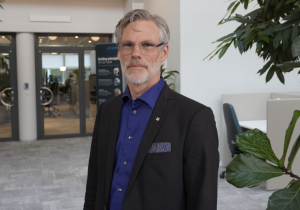
“It was so inspiring to see startup after startup using Vanguard’s machine to future-proof their devices,” recalls Magnus Marthinsson, thinking back to his visit to the innovation hub at Karlsruhe Institute of Technology (KIT) – a bit like Germany’s answer to MIT and a hotspot for applied science and research.
KIT is also where Vanguard Automation got its start – situated in a region of Germany not far from industrial powerhouses like Porsche, Mercedes-Benz, Bosch and Continental.
Photonics will be a core enabling technology for next-generation electronic devices to be smaller, faster and more energy efficient – all at the speed of light!
Smaller, faster and more energy efficient
“I could clearly see that photonics will be a core enabling technology,” says Magnus Marthinsson. “It allows electronic devices to be smaller, faster and more energy efficient – all at the speed of light! The potential applications are far reaching – from telecom and datacom to AI, AR/VR, optical and quantum computing to 3D sensing in vehicles, aerospace, defense and beyond.”
Adding a third business line to Global Technologies
Vanguard Automation has now become the third business line within Mycronic’s Global Technologies (GT) division – one of five in the SEK 7.5 billion in net sales Nasdaq-listed company that grew 24% last year. Unlike Mycronic’s more established divisions, GT acquires and grows niche advanced electronics companies with strong growth potential. These enterprises operate in a decentralized, entrepreneurial manner, often in adjacent or complementary sectors.
Think of it as a firehose of data that must be directed through perfectly sized and aligned pathways, without any splashing or loss along the way.
Successful long-term sales
“Over the past 10 years, Mycronic’s business has maintained a growth rate of 16%,” says Magnus Marthinsson, whose division reached net sales of SEK 1.1- billion last year. Recent growth has been fueled by the AI investment boom. The next challenge, he notes, is sustaining that momentum.
Now, at his side, is the team at Vanguard Automation, led by CEO Thorsten Mayer. Together they’re laser-focused on scaling the business. The team includes a group of highly skilled and committed staff – many of them PhDs – who were instrumental in building the company to where it is today.
“Before the acquisition, we quickly realized that scaling organically would be nearly impossible,” says Thorsten Mayer. “We were looking for more than just a capital investor – we wanted a strong partner who shared our vision and had a presence at tier-1 technology companies – someone who could support sales, distribution and bring real-life experience. Mycronic reached out early and stayed on the ball.”
So how does the new Photonic Interconnects business line fit into the broader market landscape? What exactly is 3D nanoprinting of photonic interconnects – and why does it matter?
“To really understand this, you have to zoom out and look at the broader shifts in the electronics market,” explains Magnus Marthinsson. “We’re witnessing an explosion of data traffic, driven by megatrends like AI, cloud computing and augmented reality.”
“Exactly,” adds Thorsten. “Chips are getting faster, but the real bottleneck now is moving data from fiber-optical cables into the chip and in-between the chips themselves. That’s why photonics – using light instead of electricity – is being built directly into chips. It enables massive data transfer at high speed and low power, using precise, 3D-printed photonic interconnects. These nano-printed optical structures simplify the challenge of routing “a firehose of data”, ensuring it flows through perfectly sized and aligned pathways without “splashing or loss” along the way.”
Thorsten Mayer points to datacenters – the backbone of internet services – as a key flashpoint. “Today, a single hyperscale data center – or cluster – can consume as much electricity as a mid-size European metropole. To handle the explosion in data, we need faster, more efficient optical links.”
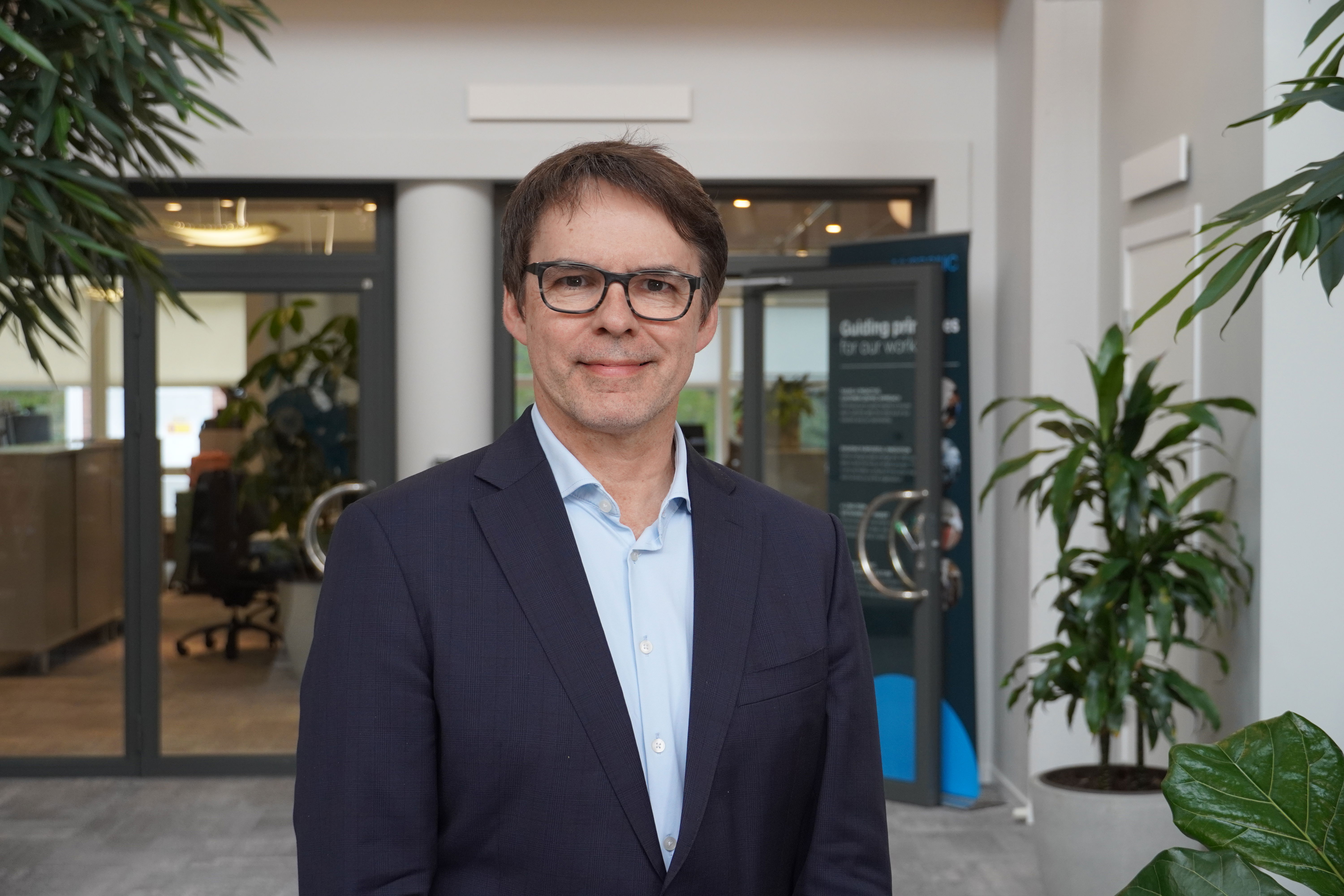
“Light is becoming what electricity was 100 years ago. We see ourselves as the connectors or enablers, lighting up the path between the optical components.”
Prior to joining Mycronic, Vanguard Automation had 25 employees. Today, the team at Vanguard Automation has grown to over 40 employees working with commercial lead customers to deploy its technology for volume production. The company has developed industrial-grade process technology for automated multichip assembly, built around its proprietary 3D-nanoprint technology. Building on a globally unique IP-portfolio, its integrated solution includes advanced machines, software and materials.
At the heart of its offering are two key product offerings. Firstly, a high-precision lithography machine that deposits photo-sensitive material to form 3D optical structures such as photonic wire bonds and micro-optical lenses. And secondly, a complementary pre- and post-processing system for material handling, cleaning, cladding, and curing to ensure yields, reliability and performance. The systems are manufactured in Karlsruhe, Germany.
Profitable since 2020
Despite being a relative newcomer – formed through a joint-venture in 2018 – the company has been profitable since 2020 and now has 40 installations globally, a majority of which in North America and Asia. “While it already counts a few noteworthy commercial customers, the customer base today primarily consists of research & innovation centers that bridge new technology into industry. The next challenge is to broaden this base to include a wider range of commercial customers.
The man who loves challenges
Thorsten Mayer, who joined Vanguard in 2021, is no stranger to taking on new challenges. Four years ago, he surprised many by leaving a senior leadership role at National Instruments (NI) – a USD 1.5 billion multinational test, automation and measurement company based in Austin, Texas. He relocated his family back to Germany to join the founders of Vanguard in a fast-moving startup environment.
From USD 300 million to USD 1.5 billion
“People thought I was crazy – and it did take some convincing for my wife and three kids,” he says with a smile. But his passion for startups had been growing as he volunteered with early-state companies in the Austin Area and found it energizing. At NI, he contributed to transforming a USD 300 million business into a USD 1.5 billion global market leader and a Best Places to Work. He felt he could share that experience with others (NI was acquired by Emerson for USD 8 billion in 2023).
Born and educated as an aerospace engineer in Germany, he quickly discovered sales, marketing and general management were a better fit. His first job after graduation was in software engineering for FEM-systems at a German software firm later acquired by NI. “Back in those days, I was lucky to have had great mentors who, in a flat organization, gave me a lot of responsibility and the space to fail, learn and grow. I still try to take a humble approach to listening and learning.”
What are the cultural differences (or similarities) with Mycronic?
“Naturally, both companies are high-tech with strong values, and a great place to work, but our cultures differ in several ways. For one thing, the photonics market is young and fast-moving, while many of Mycronic’s other divisions – even the PCB Test and Die Bonding business lines – are more mature. In photonics, we operate more like an early-stage company, with a strong focus on commercializing our cutting-edge technology.
This demands an exceptionally competent team capable of engaging with an inherently global customer base – from Silicon Valley to East Coast, Canada, Europe, and across Asia – to qualify our technology. While the technologies within GT are quite distinct, we clearly recognize potential synergies with Die Bonding.”
Operating like a real company early on
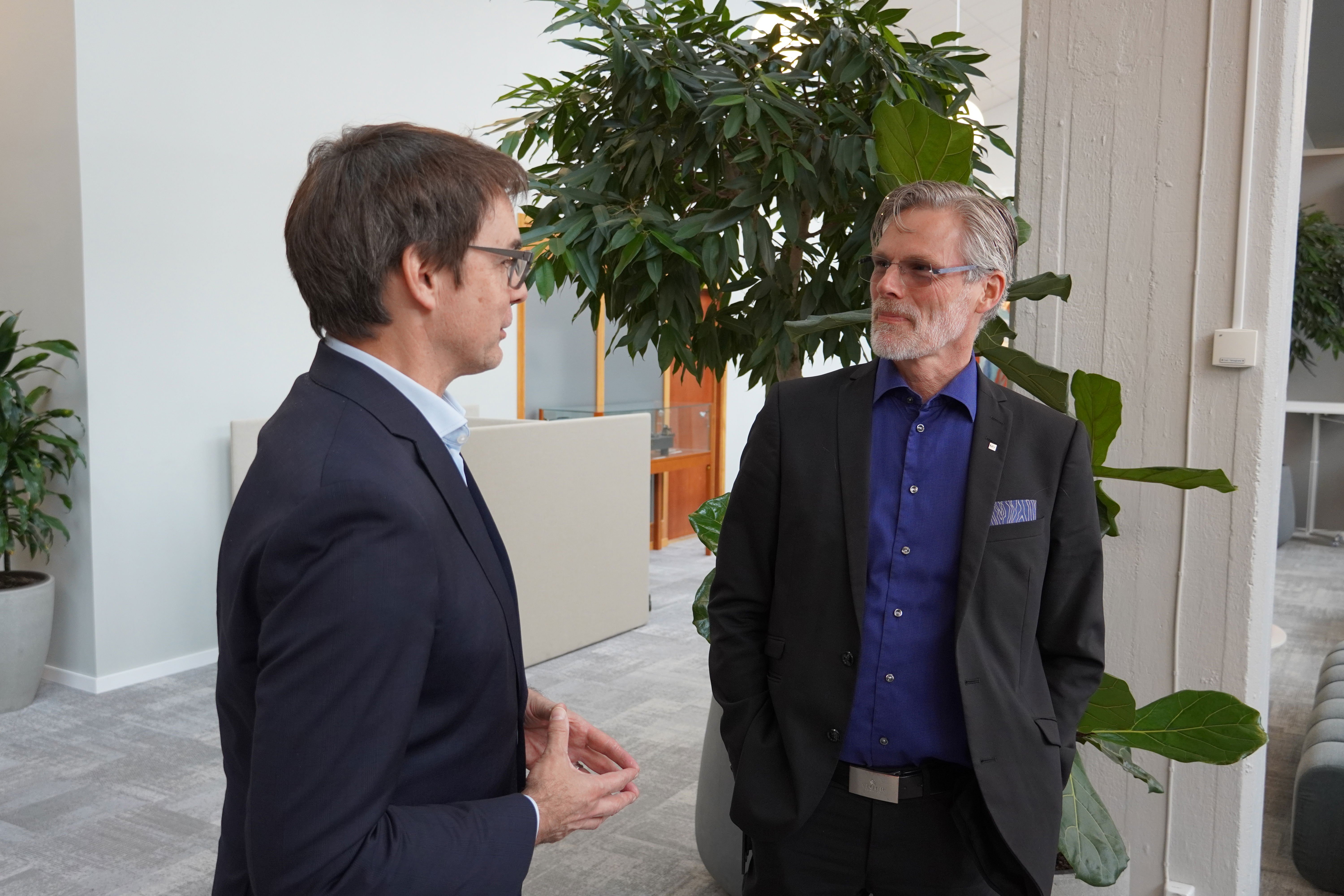
“I don’t think one should underestimate the challenges of ramping up to commercial applications,” continues Thorsten Mayer. “We’ve been fortunate to validate our business models and start operating as a ‘real company’ early on. Funding came from early investments and research projects, but soon thereafter from customers in Canada, China and North America. However, to move from selling to a few innovators and early adaptors to the majority market, we needed a strong partner – which we have found in Mycronic.”
Unlimited possibilities ahead
Magnus Marthinsson agrees: “By leveraging Vanguard Technologies unique IP portfolio for photonic wire bonding and facet-attached micro-optics, we see unlimited possibilities. Photonic integrated circuits are the future and, together we can make it happen at scale,” he concludes.