



Artificial intelligence (AI) use is exploding. More than 50 per cent of new internet content was generated by AI in 2025, according to an industry report. We even train AI on AI-generated content now and, although this can degrade performance, it continues at breakneck pace.
All this AI is consuming a lot of energy. It’s straining the electrical system, raising consumer electricity costs and breaking large-scale electrical grid planning. And the “AI energy crisis” is deepening. The International Energy Agency predicts that global electricity demand from data centres will double by 2030, to more than the electricity consumption of Japan today.
At the same time, solar photovoltaic technology — which uses the sun’s energy to generate electricity — offers the cheapest energy in the history of the planet. The sector is growing rapidly. However, both solar and AI projects threaten to take over valuable agricultural land, generating public protests.
A new study I co-authored reveals “agrivoltaics” — the use of land for both electricity generation and food production — to be a very promising solution.
In the first study of its kind, we found agrivoltaics to be a viable way to meet growing AI energy demands in the United States, while also increasing food production.
In Canada, agrivoltaics could produce enough electricity to eliminate the need for fossil fuels on the grid entirely, using less than one per cent of the country’s agriculture land.
Solar panel fences
Agrivoltaics allows farming communities to generate photovoltaic-based electricity while continuing to produce food, sometimes with even higher yields than before.
In our study, we looked at two types of agrivoltaic — vertical and single axis tracker solar — because both of them could be integrated into most farms without inconveniencing farmers.
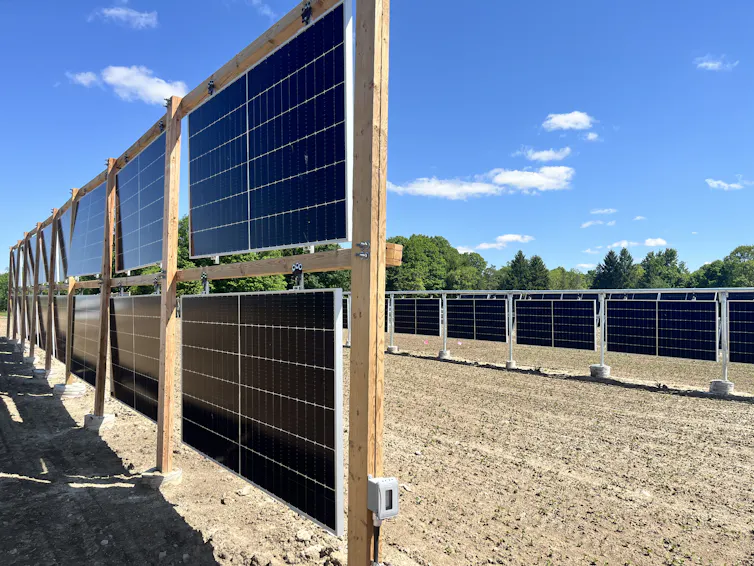
Vertical agrivoltaics are essentially fences made out of solar panels. The solar fences are spaced far enough apart that farmers can drive tractors, combines and other equipment down field rows without hitting them.
Single axis tracker solar arrays use the same trick — you just space them out for agrivoltaics. The trackers, however, track the sun and thus produce more energy per panel. When farming, they park themselves vertically just like the fences. Both of these types of solar agrivoltaics barely impact the sunlight hitting the crops, so work well with most crops.
A beneficial microclimate
Several studies of a wide variety of food crops, including basil, broccoli, celery, chiltepin peppers, corn, maize, lettuce, pasture grass, potatoes, spinach, tomatoes and wheat, have demonstrated that agrivoltaics can increase crop yield. For example, we showed strawberry yield in Ontario increased by 18 per cent in a normal year.
This is because agrivoltaic solar panels can create a “shield effect,” generating a beneficial microclimate in which plants are somewhat sheltered from sun, heat and wind.
This shield effect depends on the weather. For example, agrivoltaics generally helps lettuce, but last year’s hot summer intensified its shield effect so that lettuce fresh weight increased by more than 400 per cent compared to unshaded control plants and by over 200 per cent relative to the national average yield.