



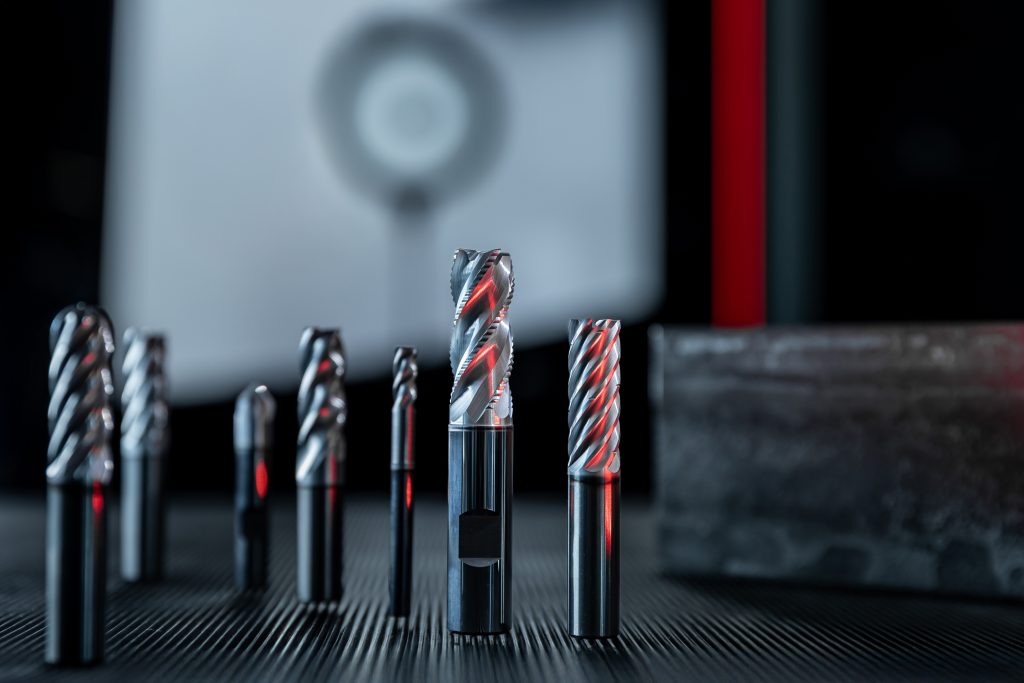
What’s happening right now—and why this could become a massive problem for industries like aerospace.
Whether it’s the machining of nickel-based alloys for discs, rings, housings, and structural parts, or the machining of titanium alloys for compressor components, housings, and shaft areas, essential tasks like these in the aerospace industry would be unthinkable without carbide tools. And that is precisely why current developments pose such a significant challenge.
Since early 2025, prices for carbide tools have been rising significantly in the market—faster and more broadly than many companies have ever experienced. Based on current market observations, price increases of around 10 to 15 percent for cutting tools used in machining and wear parts used in industrial applications serve as a rough orientation; depending on the product group and delivery model, additional surcharges of 60 to 80 percent may also apply. The range remains wide because price adjustments vary depending on the manufacturer, timing, and product family. What is particularly striking is the frequency: due to high volatility, new announcements of price increases are coming in almost daily.
“The current surge stems primarily from the raw materials side—and there, the bottleneck is tungsten,” says Andreas Lackner, spokesperson for the executive board of Ceratizit, a company within the Plansee Group, the largest tungsten supplier outside of China. “About 65 percent of the tungsten processed worldwide is used for carbide tools.”
Tungsten takes center stage: Price, geopolitics, and competition for scarce supplies
The key driver behind the price increases is therefore the situation in the tungsten market. An important indicator here is the APT price—that is, the price of ammonium paratungstate, a key trading form in the tungsten value chain. “For us, APT is something like the water level in the commodities market. When it rises sharply, that eventually—with a delay—reaches carbide tools,” explains Andreas Lackner. This APT price is more than five times what it was at the start of 2025. This is not a normal fluctuation, but a structural shift.

The origins of the tungsten shortage and the price increase are geopolitical in nature: China produces over 80 percent of the world’s tungsten and exercises control over the availability of this strategic metal through exports and export restrictions. At the same time, China has been a net importer of tungsten since 2025, as mines close and domestic consumption rises. For Western supply chains, this situation means that the shortage is intensifying, which in turn means less predictability regarding availability, lead times, and pricing.
Competition for the limited supply of tungsten products is also fierce, as this industrial key raw material is needed almost everywhere. In addition to aerospace, the entire manufacturing industry, semiconductor and electronics industries as well as medical technology require tungsten. The defense industry is also increasing its demand and building up strategic reserves in response to current conflicts. At the same time, there is a growing need for transparent, auditable supply chains; conflict minerals regulations, country-specific restrictions, and customer requirements are having an impact all the way down to raw material procurement. All of this explains the shortage, but not the available options for action.
Recycling as a counter-strategy: The fastest lever lies in circular economy
In this situation, an approach that is often underestimated is gaining traction: tungsten recycling. “The potential impact is significant because suitable processes exist and tungsten is technically easy to recover within the circular economy. Nevertheless, around 70 percent of the tungsten used worldwide does not enter the recycling stream,” explains Andreas Lackner. “In the US, there is an additional problem: large quantities of tungsten scrap are sold to other countries and flow out of the market. While this may seem attractive in the short term, it weakens the raw material base and security of supply in the long run.”
For tool users, there is a very concrete scope for action here. Those who consistently collect carbide scrap are already laying the groundwork for increasing the recovery rate and boosting availability in the region. In practice, simple yet effective measures are what counts: clear container and collection concepts, separation of other metals, and established channels for buyback programs or circular economy models.
That recycling is viable on an industrial scale is demonstrated by the Plansee Group within its value chain: Approximately 12 percent of all global tungsten products or raw materials for them originate from the Group; 91 percent of these come from recycling. This resilience is built on the systematic collection and sorting of tungsten scrap, on thermal-mechanical and chemical recycling processes, and on long-term purchase agreements with tungsten mines, including the Sangdong Mine in South Korea.
What happens without carbide tools: A decline in cutting performance, quality, and costs
For professionals in the tooling industry, carbide is not a topic that needs to be explained from scratch. Nevertheless, it is worth taking a closer look at its role within the overall manufacturing system, because that is precisely where the challenges of the current price surge lie. Carbide tools—from milling cutters and drills to indexable cutting inserts—are the standard in many applications because they open up process windows that tools made of steel can only provide in niche applications. In practice, this translates into higher cutting speeds, longer tool life, and more consistent reproducibility across batch sizes, shifts, and machines.
“Without carbide, cutting parameters decline, machine times increase, and high-strength materials like titanium or nickel-based alloys quickly become uneconomical to machine,” explains Andreas Lackner of Ceratizit. “At the same time, it becomes more difficult to maintain dimensional accuracy and surface quality consistently; and process capability as well as scrap rates come under pressure. The bottom line is that this affects not only the tool price, but the entire cost calculation: more spindle time, more setup time, more downtime, more risk.”
Conclusion: The price surges are new – the answer lies in circularity and diversification
The current price increases for carbide tools mark a new dynamic driven by raw material shortages, geopolitical restrictions, and growing competition for tungsten. For machining professionals, this means that tool prices can increasingly be explained by raw material flows.
“Anyone who is currently solely focused on short-term ways to get around the rising cost of tools is missing the point: raw material resilience. Closing loops, diversifying sources, keeping materials within the American system—these are the levers we can adjust ourselves,” emphasizes Andreas Lackner, spokesman for the Ceratizit executive board. “Recycling converts scrap back into raw material. And in a market that is currently demonstrating how quickly dependencies translate into prices, this is not a minor issue, but a matter of securing production.”
And that goes far beyond carbide tools—in aerospace, tungsten is also a key material for high-performance components such as nozzle and throat area components, heat shield and erosion-resistant parts, electron emitter, filament, or cathode applications, and much more.
With its business areas Plansee High-Performance Materials and Ceratizit, as well as its stake in Molymet, the Plansee Group is one of the world’s leading powder metallurgy companies. The company specializes in molybdenum and tungsten products and covers the entire value chain—from raw material processing to custom tools and components. The Plansee Group employs approximately 11,000 people, operates 40 production sites worldwide, and generated consolidated revenue of 2.25 billion euros in the 2024/25 fiscal year.