



By Linda Li, Chief Strategy Officer, LTG/Re-Teck
Data centers are going up faster than ever, filled with racks of increasingly powerful GPU-dense systems. But behind that momentum lies a practical, often-overlooked question: what happens to all this hardware when it’s taken out of service?
 AI models are becoming more complex, demanding exponentially greater compute power, driving hardware manufacturers to release new GPU architectures at a pace that would have seemed aggressive even a few years ago. For data center operators, the pressure to stay competitive — whether in training large language models or running inference at scale — means upgrading infrastructure at an almost frantic pace. Energy efficiency also plays a role, as newer systems often deliver greater performance per watt, making older equipment harder to justify economically. The result is a shortening lifecycle for high-end AI hardware and a growing stream of decommissioned assets. We’re entering a new phase of the AI data center lifecycle that’s as much about recovery as it is about raw performance.
There’s More Value in That E-Waste Than You Might Think
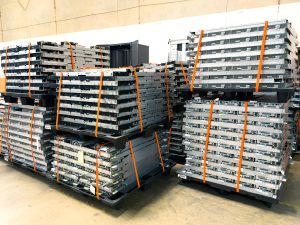
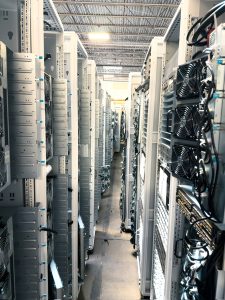
AI systems are dense with high-value components. GPUs are the obvious centerpiece, but surrounding them is high-bandwidth memory, sophisticated power supplies, advanced cooling systems, and a mix of high-value materials. They’re concentrated pockets of recoverable value, both in materials and in reusable parts that still have plenty of useful life left.
 Gold, silver, and palladium are used because some of their electrical, thermal, and chemical properties are unmatched. While precious metals offer key performance gains at the micro level, copper and aluminum are more cost-effective for power delivery (e.g., transformers), heat dissipation (heat sinks), and the physical infrastructure that makes AI workloads possible. Rare-earth materials like neodymium and dysprosium are essential to the mechanical and thermal systems that keep GPU-dense infrastructure running.
A variety of sources1 indicate that metals can be up to 50X more abundant in e-waste than in mined ore, and that the materials are already refined, alloyed, and located in accessible components. Estimates vary, but a single ton of e-waste typically contains at least 90g of gold, 400g of silver, and 200,000g of copper.
What Happens After Decommissioning
Once components are removed from service, they may take different paths. In some cases, hardware is repurposed internally, redeployed to less demanding workloads where peak performance isn’t required. This extends the useful life of the equipment and delays the need for disposal.
Other components get refurbished and resold into secondary markets. GPUs, memory modules, and power supplies that can be properly tested and certified often retain significant value, especially as demand for compute continues to outpace supply in many sectors. However, these components are subject to restrictions imposed by original manufacturers and government authorities, so remarketing must be carefully assessed and audited, and all service partners must comply with strict rules.
Then there’s what’s increasingly called “urban mining” — extracting valuable materials from retired systems rather than traditional mining. Copper and aluminum can be recovered at high rates, while precious metals and rare earths are more complex to process, but at scale, they represent real economic upside.
Of course, not all hardware can be reused or economically harvested. In those cases, responsible disposal becomes essential. That means complying with environmental regulations, handling hazardous materials properly, and adhering to strict data destruction protocols. For AI data centers, where sensitive information may reside on decommissioned systems, the chain of custody and certified data erasure are critical elements of the process.
The Increasing Importance of Circular Economies
 From a sustainability perspective, the stakes are high. Manufacturing new hardware is resource-intensive, drawing on finite materials and energy-heavy processes. Moving from the traditional “take-make-waste” linear model to a circular economy that, in part, recaptures e-waste as a manufacturing resource is good for the environment and equally a business’s bottom line.
To add perspective, the Global E-Waste Monitor 2024 reported that the world generated 62 million metric tons of e-waste in 2022, of which only 22% was properly collected and recycled. The potential for metal recovery from e-waste is currently valued at around $37 billion USD. Certainly not all of that e-waste came from data centers, but they are a significant contributor.
Looking ahead, the industry is beginning to rethink how hardware is initially designed. Concepts like modularity and design for disassembly are gaining traction, making
hardware easier to repair, upgrade, and eventually recycle. Standardization efforts and policy initiatives are also encouraging the industry toward more circular models. The goal is to move AI infrastructure away from a linear pipeline that ends in disposal and toward a loop in which materials and components flow continuously back into use.
Thinking Long Term
For a long time, IT asset disposal was treated purely as a cost center. However, the rapid turnover of GPU-heavy systems is creating a layer of economic and operational opportunity that most organizations are still figuring out how to capture. Decommissioned hardware is becoming a strategic opportunity for data center operators.
With the right processes and partners, organizations can recover real value from retired equipment. Modern extraction techniques have proven that material reclamation of metals and rare-earth materials is now financially viable. Equally compelling is that material reclamation effectively creates a domestic, renewable supply of critical materials. Unlike mining, which is environmentally challenging and geopolitically constrained, recovering materials from existing products can be scaled more quickly and sustainably. It also mitigates risk associated with trade disruptions, export controls, and price volatility.
The organizations that get this right, that invest in the processes, partnerships, and thinking needed to extract value at end of life, will be better positioned for long-term success in a market that’s increasingly constrained by both resources and sustainability expectations. Forward-thinking operators are already building recovery value into their total cost of ownership models because end of life doesn’t have to mean end of value.
1 https://pmc.ncbi.nlm.nih.gov/articles/PMC12828617/,
https://www.sciencedirect.com/science/article/abs/pii/S0892687525001839,
https://www.scientificamerican.com/article/e-waste-could-become-a-gold-mine-for-rare-earth-elements/