


On Location in Washington DC with the Global Electronics Association: on AI, robotics, tariffs, talent, and the forces reshaping the industry in 2026. You can watch the full versions of the video interviews in the EMS@C-Level Playlist
By Philip Stoten, Journalist, Speaker and Podcaster
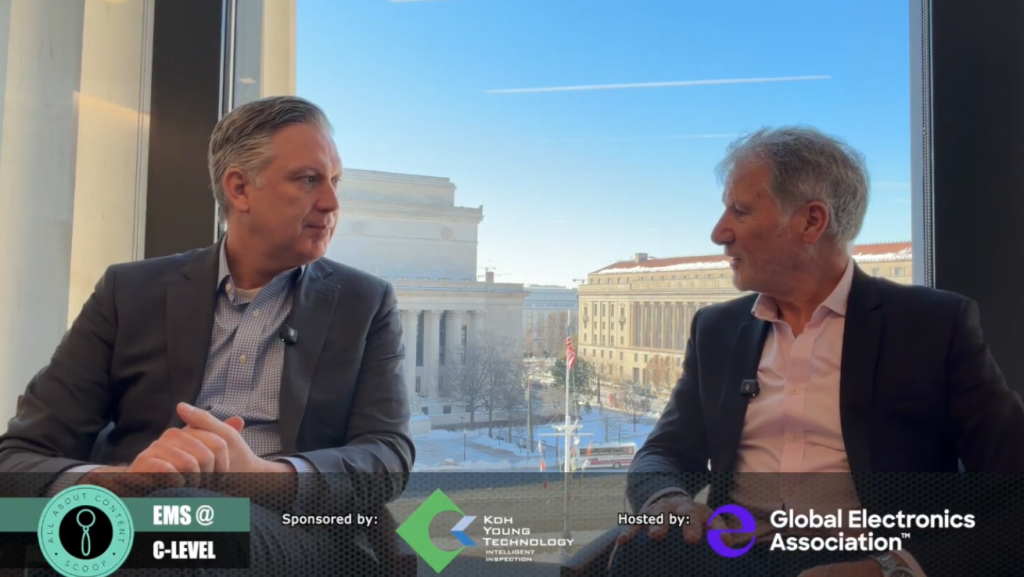
Washington, DC. in early February, as the industry digests CES and prepares for APEX, there are few better places to take the temperature of global electronics manufacturing than the headquarters of the Global Electronics Association. Over the course of a day of conversations at the organisation’s Washington offices, I sat down with President and CEO John Mitchell, VP of Global Government Relations Chris Mitchell, and Chief Economist Shawn DuBravac. What emerged was a coherent and striking picture: an industry that has absorbed extraordinary disruption, and an association that is building serious new muscle in data and advocacy, together approaching a genuine inflection point.
The conversations ranged from artificial intelligence and humanoid robots to tariffs, talent pipelines, and the growing strategic importance of the EMS sector in the world’s innovation ecosystem. What united all three was a sense of momentum, cautious, evidence-based, but real.
A Name That Finally Fits
When IPC rebranded as the Global Electronics Association last year, there was understandable nervousness about changing one of the most recognised names in the industry. John Mitchell, who has led the organisation for over a decade, recalls the decision with characteristic pragmatism. “We cheated a little,” he says. “We kept IPC. We still have IPC standards, we still have IPC certification, but now the overarching brand is the Global Electronics Association, which really just represents who we are.”
The transition proved smoother than many anticipated. By the end of the year, the new name had settled naturally into industry vocabulary, in part because, as Mitchell acknowledges, the organisation had already been operating as a global body for years. The name change was less a reinvention than a recognition.
But with a larger name comes a larger responsibility. The organisation has been restructuring accordingly: a new VP dedicated to US and Canada, a split of Asia into East Asia and Indian Southeast Asia with dedicated leadership for each, and a growing focus on Mexico. The logic is straightforward, if you are going to speak for a global industry, you need genuine presence in every region that matters.
Mitchell frames the industry’s broader purpose in terms that go well beyond electronics manufacturing. “Water is necessary for life,” he says. “Fossil fuels drove the industrial revolution. Electronics are that next game changing resource because it cuts across every single industry. Without electronics, you don’t have AI, you don’t have robotics, you don’t have automation. Electronics are the innovation resource for every other industry in the world.” It is a bold claim, but not an unreasonable one.
Watch the John Mitchell video here>>
The AI Question Nobody Can Fully Answer
Artificial intelligence dominated discussions at CES, and it dominated our Washington conversations too, though with considerably more nuance than the marketing hype that typically surrounds the subject. John Mitchell is visibly impatient with the looseness of the terminology. “I get a little testy about AI,” he admits. “Marketing folks are throwing around the term with way too much frequency.”
Shawn DuBravac takes a more dispassionate view. Fresh from the CES floor, he describes AI not as a product category but as a structural force, one already crowding out investment in other areas, reshaping semiconductor demand, and beginning to define which companies and sectors thrive. “Even if you aren’t building for AI and you’re not in that supply chain, you’re being impacted by what’s happening there,” he says. “The build-out you’re seeing is incredible. And that’s crowding out investment in other places.”
On the financial sustainability of the AI investment wave, DuBravac is cautiously optimistic. Unlike previous technology bubbles, much of the current build-out is being funded by the hyperscalers’ own cash flows rather than debt financing. That reduces, though does not eliminate, the bubble risk. The more immediate danger, he suggests, is that if those companies perceive a slowdown in demand, they will cut back quickly, and the ripple effects across the electronics supply chain would be felt fast.
The most profound question, however, is the one Mitchell raises about talent. The shift from generative to agentic AI, systems that act autonomously rather than simply respond, creates a troubling paradox for workforce development. “The kinds of tasks agentic AI will do very well are repetitive tasks,” he explains. “Well, think about your incoming population of students, people just entering the industry. What are the first jobs that they do? Exactly those things. So where are they getting the skill set to move to the higher level jobs when the people currently in those roles retire?” It is a question without a clean answer, and Mitchell is candid about that. His response is to lean into the Global Electronics Association’s core value proposition: bringing hundreds of companies together to build industry-wide training standards that no individual member could sustain alone.
Watch the Shawn Dubravac video here>>
Robotics: Closer Than You Think, Further Than You’re Being Told
If AI is the dominant story of 2026, robotics, and the humanoid form factor in particular, is the one building momentum beneath it. DuBravac counted over 40 different humanoid robots on the CES floor, a figure that reflects both genuine technological progress and a fair amount of competitive theatre. “There were some that are dancing in the hallways, and then there are others that really look like they’re ready for prime time manufacturing deployment,” he says. “We’re still earlier than the robot manufacturers want us to believe, but you look at some of their time horizons and they’re looking out 36 to 48 months for deployment in manufacturing environments. And even if they’re wrong by half, you’re still looking at the next six to eight years.”
John Mitchell points to a familiar technology adoption curve. “For US$5,000 you can now have your own robot,” he notes. “It wasn’t too long ago that 3D printing was five grand, and now it’s just a couple of hundred bucks.” Price compression, in other words, is already underway, and the implications for factory economics are significant.
For the EMS industry, DuBravac frames robotics not as a future option but as a structural necessity. The US alone is already several hundred thousand manufacturing workers short, a figure that could reach several million by 2030 on current trends. “You do start to run into an environment where you don’t have the labour you want, and so you have to start to reconfigure what your capital labour ratios look like,” he says. The manufacturers best positioned to lead that transition, he suggests, are those already thinking in systems and automation, not those who have been doing things the same way for twenty years.
Tariffs: From Panic to Strategy
The trade disruption of 2025 was, by any measure, extreme. But the conversation in Washington in early 2026 is markedly different from the one I was having with EMS leaders a year ago. What was urgent and destabilising has become, if not comfortable, then at least manageable. DuBravac describes it as one of the more surprising findings of the past year. “What surprised us most was how quickly companies were able to react, and how much agility they showed in shifting major parts of their supply chain,” he says. “We also saw a lot of cost absorption throughout the supply chain, so consumers weren’t impacted by the full extent of tariffs. I’m not sure that will continue forever, there’s only so much absorption that can take place.”
John Mitchell, meanwhile, is clear-eyed about what has made the situation genuinely difficult, and it is not the tariffs themselves so much as the frequency of change. “Every time there’s a change, every single one of your customers wants to know what the impact is for them,” he explains. “And if it changes again next week, you’ve got to do that work all over again. There’s a lot of spinning going on and really a lot of inefficiency with the frequency of changes.” The industry, he notes, is fundamentally good at handling change, it is the nature of electronics. What it struggles with is change that feels purposeless.
Looking ahead, DuBravac expects continued consolidation in the EMS sector, with M&A activity driven in part by the need to establish or strengthen geographical footholds. “There’s still a lot of push to build more manufacturing capacity in the US,” he says. “M&A would be a natural way of gaining footholds there.” Whether new greenfield capacity follows will depend, he argues, on policy clarity, manufacturers need to believe the demand environment is sustainable before committing to new plants and facilities.
Building the Data Muscle
Across all three conversations, one theme kept resurfacing: the importance of data, not raw numbers, but actionable intelligence that helps members make better business decisions. Chris Mitchell, who leads the organisation’s government relations work, is building out the Global Electronics Association’s industry intelligence programme with new regional hires across North America, Europe, and Asia. The goal is not just more data, but data that can be interrogated in real time, sliced by sector and geography, and used to drive decisions rather than simply describe the past.
Watch the Chris Mitchell video here>>
“What we find is that companies want research and data that helps them make business decisions,” he says. “And if we can provide that, we get a very positive response.” He acknowledges the challenge: there is a large appetite for data in the industry, but not always a corresponding willingness to share it. Building a programme that generates genuine return, for members and for the organisation, requires careful prioritisation.
Shawn DuBravac, who sits at the top of this data pyramid as Chief Economist, is equally focused on the shift from reporting to insight. “Members are looking for information to help them make decisions,” he says. “They want to be able to look forward and see what’s coming and how to prepare for it, not use the rear view mirror.” The partnerships the Global Electronics Association has built with data providers in Europe, and is now extending across Asia, are central to that ambition.
Chris Mitchell also frames the data programme as essential infrastructure for the organisation’s advocacy work. “Governments more often than not do not have the data that policymakers feel they need to make really smart decisions,” he says. “That’s where the partnership with government comes in. If we can’t all agree on what the industry is challenged by, how are we ever going to come to agreement on what the right policy solutions are?”
A More Important Role Than Ever
Perhaps the most striking observation across all three conversations was the EMS industry’s evolving position in the broader electronics ecosystem. Chris Mitchell puts it plainly: outside the industry itself, the EMS sector is still underappreciated. “People don’t always understand that EMS companies are not just a passive receiver of orders, they are true drivers of a lot of the innovation we’ve seen, not just on the technology side but in how we’re able to produce electronics at competitive prices and very high quality,” he says.
That story is becoming easier to tell. As OEMs think more seriously about supply chain risk, surge capacity, and the strategic value of deep manufacturing partnerships, the EMS industry is, in DuBravac’s words, “poised to play an even far more important role in the future.” The companies that have invested in those partnerships, and in their own sophistication as manufacturing partners, are well placed for what comes next.
John Mitchell, characteristically, brings it back to people. “Everybody can buy the parts, everybody can buy the equipment,” he says, quoting one of The Association’s members. “The differentiation is the people and how they use that stuff.” In an era of AI agents, humanoid robots, and supply chain restructuring, it is a reminder worth holding onto.
Philip Stoten is a journalist, podcast host, and publisher covering the global electronics manufacturing industry. He hosts the EMS@C-Level podcast.