


Software pricing evolves: From licenses, to SaaS, to consumption
Vendor software monetization has evolved over the decades, with pricing models shifting significantly over the last 50 years:
- 1980s-1990s: Product licenses
- 2000s: Subscription, SaaS, and seat-based pricing
- 2020s: Emergence of consumption, per-action, and outcome-based pricing
Per-seat and subscription pricing is being replaced with per-action, per-process, or per-outcome pricing models. Vendors are also investing in “storefronts’ and royalty-based models, such as app stores for agents. Micro-consumption pricing now dominates, charging for each AI interaction or query, which reflects the underlying cost structure of AI services.
As a result, new vendor pricing models for the Agentic AI era are emerging:
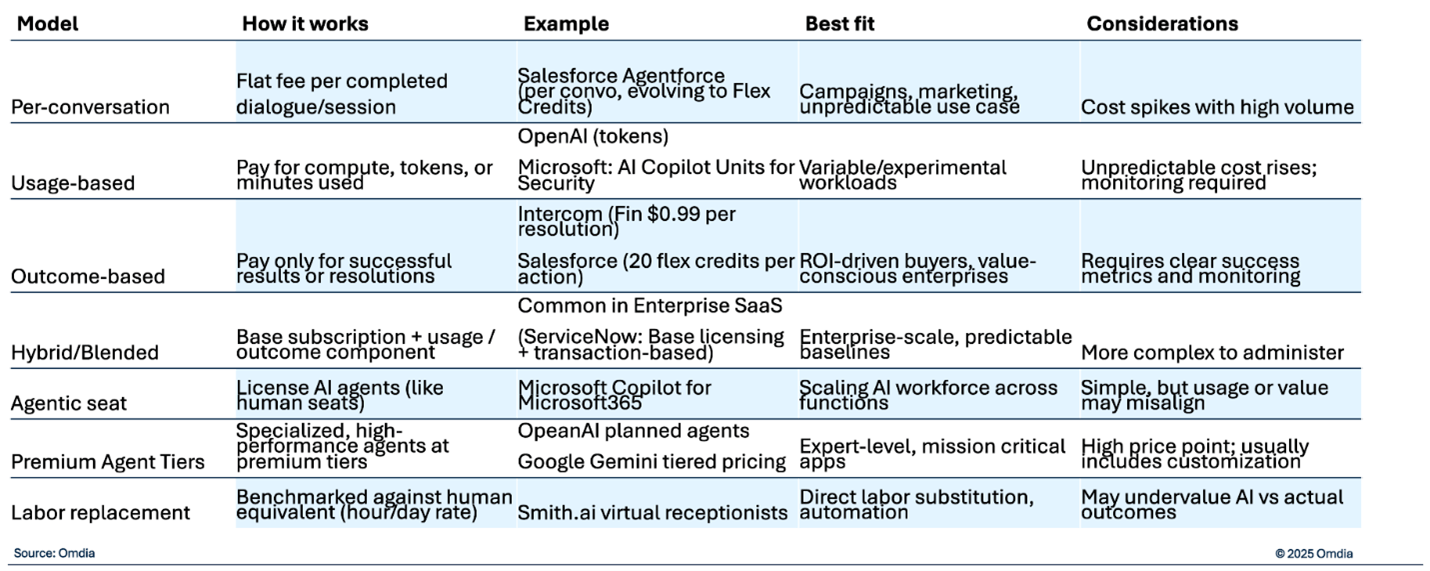
Salesforce’s new Flex Credits for Agentforce is an example of this pricing evolution. Flex Credits is a consumption-based model where customers pay only for specific actions taken by agents in small packages ($500 per 100,000 credits, 20 Flex Credits per action). The flexible pricing approach allows customers to start small, experiment with different use cases, and then scale their success across the enterprise. Expect more flexible pricing announcements in the future as the industry focuses on helping customers cross the chasm and vendors compete for new customers.
New partner strategies for monetizing Agentic AI
For partners, this pricing shift creates both challenges and opportunities. Partners must adapt their business and expertise to:
- New compensation models aligned with vendor consumption-based pricing
- Value-based selling focused on business outcomes over features
- Continuous engagement and optimization to ensure adoption and usage
- Consumption optimization expertise to track, manage, and optimize variable usage costs and their own margins.
Outcome-based pricing also requires partners to rethink packaging strategies. Instead of margins on resale or billable hours, the new paradigm rewards impact, outcome alignment, and agent orchestration. Partners who can demonstrate clear ROI through outcomes will command premium pricing in this new paradigm.
Partners will leverage five primary pricing models in the AI era:
- Outcome-based pricing tied to measurable business results (e.g., cost reduction, revenue growth, CX metrics).
- Consumption-plus models add a margin to underlying API costs while providing optimization services.
- Subscription and managed services for agent management.
- IP monetization: agents developed for niche verticals sold across accounts.
- Hybrid models combining implementation and build services with ongoing optimization fees
Five pillars for winning in the Agentic AI economy
Winning the agentic AI economy requires new muscles in five areas.
- Data Foundations: Creating unified, well-governed data ecosystems with semantic layers and feedback loops
- Talent & Training: Developing specialized AI capabilities through strategic hiring and upskilling
- Specialization & IP Development: Building proprietary solutions targeting specific verticals and use cases
- Ecosystem Orchestration: Forming strategic partnerships across the AI stack
- Human-Centered Adoption: Focusing on change management and measuring success through business outcomes
Defining your strategic roadmap for the AI era
Success in the agentic AI era isn’t about being everywhere – it’s about being brilliant somewhere. The channel is fragmenting into specialized domains, and partners must pick their lane, define it, and dominate it in the AI era.
Download this comprehensive report to explore the full analysis of the $267bn AI services opportunity and develop your strategic roadmap for success in the age of AI.