


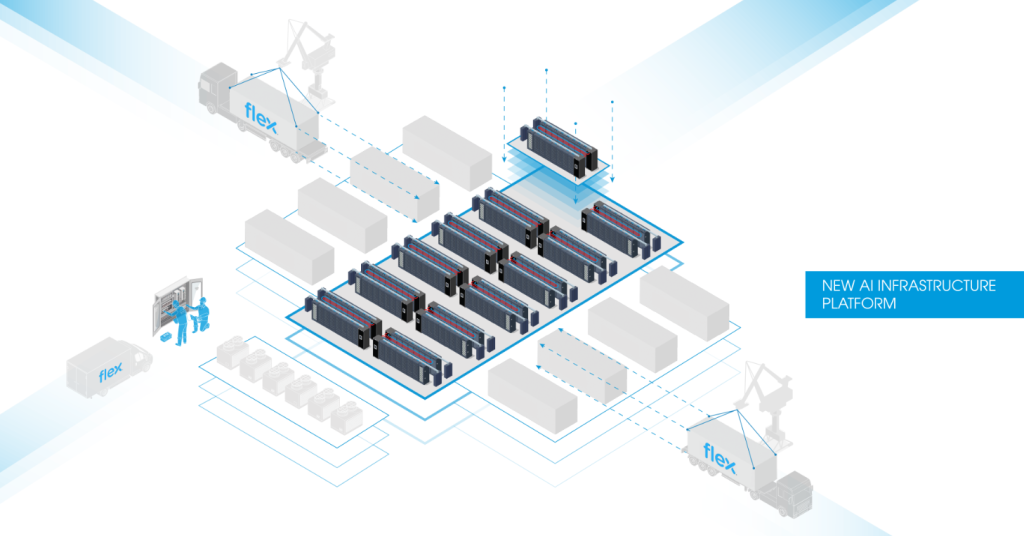
Flex today announced what they are calling the industry’s first globally manufactured, fully integrated platform designed for gigawatt data centers supporting AI and HPC. By uniting power, cooling, compute, and Flex’s global services into pre-engineered, modular reference designs for next-generation data centers, executives say the new infrastructure platform enables operators to deploy infrastructure up to 30% faster, reduce execution risk, and scale reliably to meet the pace of AI demand. Flex will highlight the platform and new breakthrough products during the OCP Global Summit in booth B24.
“As AI adoption accelerates, data center operators must overcome rising power, heat, and scale challenges to deploy infrastructure at unprecedented speed,” said Michael Hartung, president and chief commercial officer at Flex. “Flex delivers the industry’s deepest hardware stack by integrating power, cooling, and compute with vertically integrated manufacturing at scale. Its open architecture provides the flexibility required for faster, more predictable deployments, enabling data center operators to keep up with AI demand.”
According to the announcement, traditional bespoke build approaches are more complex and often involve longer construction times, schedule risks, and unpredictable performance and costs. Flex unites the essential building blocks of AI-scale infrastructure, bringing together Flex’s portfolio of power and cooling products and rack integration capabilities into pre-engineered designs.
Key advantages include:
- Faster deployment: Up to 30% faster time-to-market, accelerating revenue recognition.
- Integration as innovation: A unified platform that enables rack, cooling, and power breakthroughs.
- Deepest hardware stack in the industry: Integration of compute with critical infrastructure for higher performance and efficiency.
- Flexible, open architecture: Partner-friendly and adaptable to customer-preferred OEMs.
- Lifecycle intelligence: Built-in monitoring, predictive analytics, and system-level optimization.
EMSNOW reached out to Chris Butler, President of Critical and Embedded Power at Flex to learn more.
EMSNOW: Experts have expressed concerns for the environmental impact for building these datacenters. Does having this integrated platform address environmental issues?

As data center architectures evolve to accommodate megawatt-scale racks, the power and cooling systems required for AI and HPC environments evolve as well. We collaborate closely with chipmakers and hyperscalers to develop solutions that will enable the technologies of the future — and many of those solutions are aimed squarely at increasing power and water usage effectiveness to support data center operators’ sustainability goals. The Flex AI infrastructure platform integrates advanced technologies such as high-density, liquid cooled IT racks, capacitive energy storage systems, and coolant distribution units (CDUs) that help data center operators reduce power losses, improve power quality, and manage heat with considerably less water consumption than traditional air-cooled methods. Offering an integrated platform that incorporates forward-thinking technologies makes it easier for data center operators to deploy infrastructure that is engineered to for more efficient use of resources. In addition, we manufacture our data center racks using sustainable materials such as green steel, and our circular economy services encourage the responsible reuse of materials.
EMSNOW: What is the impact on electric grid? Deployment speed is important, but also what about the short term impacts on the grid?
As it stands, power grids cannot keep up with the exponential growth of compute and associated energy requirements for AI and HPC workloads. Today, nearly half of data center energy goes to compute, with the other half going to cooling – making it essential for data center operators concerned with growth and profitability to focus on improving both. They can’t do it alone. They must rely on collaborative partners whose product innovations can help them meet their financial and sustainability goals and make the best use of available power. So, while deployment speed is undeniably important to meet current and forecast demand, sustaining modern data centers long-term requires attention to how they operate, not just what they produce. If it costs more to deliver compute — including the cost to secure adequate sources of energy — than people are willing to pay to consume it, the math simply doesn’t work. Profitability is dependent on operational efficiency, and all roads lead to effective use of energy.
EMSNOW: What are you seeing in terms of global demand for this at Flex?
As data center operators work to deploy infrastructure at unprecedented speed, we’re seeing strong demand for prefabricated, modular solutions. Traditional bespoke build approaches are more complex and involve longer construction times, schedule risks, and unpredictable performance and costs. By leveraging pre-engineered modular solutions like Flex’s AI infrastructure platform — built and tested offsite — data center operators can install systems more easily, reduce onsite labor, build faster, and reduce project risks.
The platform debuts with several breakthrough Flex product innovations and capabilities across the full stack:
- 1MW racks — High-density, liquid-cooled IT rack and OCP-inspired power rack, designed to support +/-400V and enable the transition to 800VDC power architectures for next-generation AI infrastructure.
- Capacitive Energy Storage System — First-to-market UL 1973–certified capacitor energy storage system, reducing electrical disturbances from AI workloads.
- Modular rack-level coolant distribution unit (CDU) — A scalable CDU, delivering up to 1.8 MW of flexible capacity to support evolving AI, HPC, and hyperscale workloads, backed by comprehensive global support and warranty coverage.
- Prefabricated power pods and skids— Pre-engineered modular systems simplify installation, cut onsite labor through parallel construction and fewer interconnects, and shorten build times. By leveraging offsite assembly, customers cut weeks from construction schedules and save thousands of hours of onsite labor, reducing deployment from 12+ months to just 6–12 months.
Flex’s global manufacturing and supply chain network underpins the platform and new products, delivering unmatched scalability, resilience, and deployment speed. In addition, Flex provides global services that support the full lifecycle of AI infrastructure, from design and sourcing through deployment, fulfillment, and circular economy. This ensures customers benefit not only from integrated hardware, but also from end-to-end support that improves reliability, sustainability, and speed to scale.