




By Henry Lee, CEng, EMBA
Recent global disruptions have exposed critical vulnerabilities in maritime logistics supporting the Electronics Manufacturing Services (EMS) industry. A new study reveals surprising differences in how manufacturing and logistics stakeholders approach blockchain-enabled solutions for supply chain resilience, while uncovering significant capability gaps that impact implementation success.
Supply Chain Disruptions Driving Digital Transformation

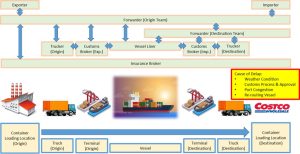
Since 2018, three major disruptions have fundamentally changed global supply chains: the U.S.-China trade war that shifted trade patterns and disrupted logistical planning; the COVID-19 pandemic that triggered unprecedented global disruption with factory and port closures; and Russia’s invasion of Ukraine that drastically increased maritime transport costs. These disruptions created two critical pain points for EMS providers:
- Price Fluctuation: The Baltic Dry Index rose 700% between March 2020 and 2022, with door-to-door costs for some shipping routes increasing nearly 200%.
- Process Inefficiency: Major shipping alliances canceled over 100 sailings between June and August 2020, leading to equipment shortages, backlogs, and schedule reliability falling to unprecedented levels.
For EMS providers, both inbound logistics for component delivery and outbound logistics for finished product shipment became unpredictable, severely impacting production planning and cash flow.
Key Findings Across Sectors
The research employed Analytic Hierarchy Process analysis with 48 manufacturing and 17 logistics professionals, complemented by interviews with industry leaders including one of the world’s top 10 global freight companies and several public-listed EMS providers.
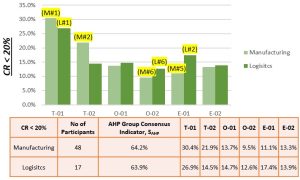
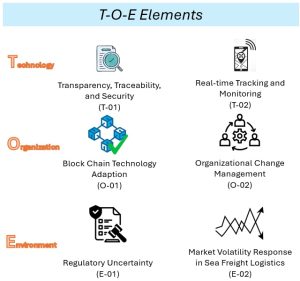
Both manufacturing and logistics sectors ranked Transparency, Traceability, and Security as their top priority (30.4% and 26.9% respectively). However, significant differences emerged in their secondary priorities:
- Manufacturing firms prioritized Real-time Tracking and Monitoring (21.9%)
- Logistics companies emphasized Regulatory Uncertainty management (17.4%)
This divergence highlights how each sector’s operational context shapes their approach to digital transformation. Manufacturing’s emphasis on tracking technologies reflects the critical importance of supply chain visibility for production planning, while logistics professionals’ focus on regulatory compliance demonstrates their direct exposure to constantly evolving international trade regulations.
The Digitalization Gap
Perhaps most revealing was the substantial capability gap between industry leaders and the broader market. While top-tier companies like Flex (US$30.35 billion revenue) have implemented sophisticated Transportation Management Systems with comprehensive visibility capabilities, approximately 50% of documentation processes remain manual across the industry despite advanced ERP implementations.
“Approximately 50% of our documentation is still processed manually,” admitted one Senior Director of Supply Chain & Logistics Management at a major EMS provider. Another executive noted, “Electronic data exchange could significantly improve our productivity and reduce dwell time.”
This capability disparity extends beyond just documentation. The research found that industry leaders demonstrate advanced implementation of digital solutions enabling optimized partner selection, service combinations, and proactive shipment tracking, while capabilities that remain aspirational for most mid-tier providers.
Push vs. Pull: What Drives Adoption?
One of the study’s most striking insights came from a top 10 global freight company that had previously attempted a blockchain platform initiative which was ultimately discontinued. Their experience revealed that a technology-pushed approach to digital transformation, even when led by industry leaders, often fails to gain traction.
Instead, successful digital transformation is more effectively achieved through regulatory frameworks and clear market demands rather than technology-pushed solutions. This finding mirrors recent examples like the European Union’s USB-C mandate and its impact on industry practices.
As one logistics executive noted: “A pull approach driven by government regulations or customs requirements could be more successful in driving widespread adoption.”
Financial Benefits of Blockchain Implementation
The research identified three key areas where blockchain technology offers transformative potential for maritime supply chain finance:
- Working Capital Optimization: Reducing cash-to-cash cycles through automated verification of shipping milestones and enabling inventory financing based on verified container location and condition. Digital bills of lading on blockchain platforms can reduce document processing time from the industry standard of 3-7 days to minutes.
- Trade Finance Transformation: Creating digital platforms that enable suppliers to access working capital based on anchor-supplier relationships. Companies like Samsung and Foxconn have established funds to enable Tier-1 suppliers to finance Tier-2 suppliers, demonstrating practical applications of this approach.
- Maritime Credit Market Expansion: Opening vessel financing opportunities to non-traditional lenders through standardized, verifiable performance data. According to UNECE research, digitized trade documentation can reduce transaction costs by up to 15% of the value of goods traded.
Pragmatic Implementation Framework
Based on these findings, the research recommends a three-phase implementation approach tailored to sector-specific priorities:
Phase One: Focus on documentation digitization and process standardization to address the primary concern of transparency across both sectors. This includes comprehensive documentation flow analysis, prioritized digitization based on empirically-derived matrices, and integration with existing ERP systems.
Phase Two: Enhance real-time visibility systems (for manufacturing) and regulatory compliance capabilities (for logistics) based on each sector’s unique priorities. This includes developing federated IoT architecture for container-level tracking and implementing predictive compliance analytics.
Phase Three: Implement organizational transformation strategies to address change management—an area both sectors consistently underestimated in importance. This includes systematic blockchain capability development and establishing formal governance structures.
The Blind Spot: Organizational Change
Both manufacturing and logistics sectors ranked Organizational Change Management as their lowest priority (9.5% and 12.6% respectively). This consistent de-prioritization suggests a potential blind spot that could hinder successful implementation if not adequately addressed.
The research found that despite recognition of digital transformation’s importance, actual implementation behaviors often lag behind stated intentions. This gap between aspiration and execution appears more pronounced in organizations with limited resources, where the requirement for clear financial returns often outweighs long-term strategic benefits in investment decisions.
Conclusion
As supply chains face persistent disruptions, strategic digital transformation in maritime logistics has become essential for EMS providers. However, this research demonstrates that successful implementation requires more than just technology adoption; it demands sector-specific strategies that balance immediate operational benefits with long-term strategic value.
Most importantly, it reveals that even major industry players face significant challenges in coordinating complex stakeholder ecosystems. The path forward requires both technological solutions and thoughtful approaches to organizational change, regulatory frameworks, and cross-sector collaboration.
About the Author:
Henry Lee, CEng, EMBA is a manufacturing transformation executive with over 25 years of leadership experience in Professional Audio and MedTech industries. A Chartered Mechanical & Manufacturing Engineer specializing in digital transformation, Henry has led breakthrough innovations that revolutionize operations and supply chain efficiency. He is currently pursuing doctoral research exploring the impact of exponential technologies on supply chain ecosystems.