


By Dr. Akin Akturk, Co-founder of CoolCAD Electronics Inc.
In this paper, Dr. Akin Akturk explores the critical issue of radiation-induced failures in power semiconductor devices for space applications. He begins by referencing NASA’s technological objectives for power devices in space, emphasizing areas requiring advancement. Terrestrial and space radiation hazards as well as failure modes are examined along with current mitigation strategies. He discusses the technical challenges and the research that are shaping engineering approaches to enhance radiation resilience. Lastly, he highlights CoolCAD Electronics’ SiC-based technology that promises to deliver advanced radiation-hardened power devices that align with NASA’s ambitious objectives.

NASA’s Technology Roadmap for Space Power

Boosting power availability is top priority in NASA’s technology roadmap. Power is vital for both human and unmanned space exploration endeavors and is particularly crucial for NASA’s future ambitions.
In my role at CoolCAD, I work with a pioneering team of engineers focused on developing next-generation silicon carbide (SiC)-based semiconductor power devices that operate reliably under the most demanding conditions. We are one of a few companies that have been commissioned by NASA to advance power technology for space, including the development of:
- Next-generation radiation-hardened semiconductor power devices resistant to damage from radiation, including low- and high-energy particles (neutrons, protons, electrons, and heavy ions), x-rays, and gamma-rays.
- Substantially more compact power systems to reduce the volume and mass of future space mission payloads, currently constituting a third of a spacecraft’s mass at launch.
- Discrete power semiconductor devices capable of reliable operation at higher bias voltages and frequencies compared to current systems, eliminating the need for voltage derating that necessitates component stacking to achieve higher power output.
- Power systems resilient to extreme forces of acceleration, deceleration, and temperature variations spanning from -270oC to 400oC.
The Silent Threat of Space Radiation
 Radiation presents a significant threat to electronic devices, both in the terrestrial environment and in space.
- In the terrestrial environment, cosmic rays and solar particles penetrate the earth’s atmosphere, interacting with nitrogen and oxygen atoms to generate secondary neutrons. These terrestrial neutrons pose notable risks to aircraft electronics as well as ground vehicles.
- In Low Earth Orbit (LEO), devices face moderate levels of radiation primarily from protons and heavy ions. These particles pose a significant threat to electronics used in satellites as well as spacecraft such as the International Space Station (ISS).
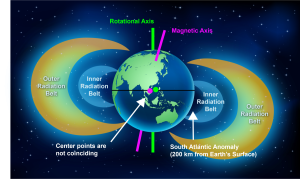
- Beyond LEO lie the Van Allen belts. These donut shaped radiation clouds contain billions of high-energy particles originating from solar winds and held in place by the earth’s magnetosphere. The Van Allen belts are renowned for posing substantial risk to both astronauts and radiation sensitive electronics.
- The South Atlantic Anomaly, located over the South Atlantic Ocean, periodically exposes satellites and spacecraft in orbit above the earth’s surface to intense ionizing radiation. Traversing through the South Atlantic Anomaly is thought to have contributed to the failure of Globalstar network satellites in 2007.
- Beyond the Van Allen belts, space radiation consist of a broad spectrum of x-rays, gamma-rays, protons, electrons and charged nuclei of elements ranging from hydrogen (alpha-particles) and helium (beta-particles) to the heavier elements, up to and including iron.
Understanding and mitigating these radiation hazards are crucial for success and safety of space missions.
Battling Electronic Failures in the Cosmic Arena
The complex mixture of radiation in space can damage electronics in a variety of ways. Damage can occur abruptly from a single ion strike or can develop gradually over time and can lead to a transient malfunction or a catastrophic failure.
Displacement Damage (DD) occurs when high-energy particles displace atoms within the semiconductor crystal lattice. A displaced atom can trigger a cascade of additional atomic displacements. Over time, DD can significantly affect material properties and electrical performance. While shielding is commonly used to mitigated DD, it comes with the drawback of added cost, volume and mass.
Total Ionizing Dose (TID) refers to cumulative ionization that results in gradual failures. In Metal-Oxide-Field-Effect Transistors (MOSFETs), positive charged defects become trapped and accumulate near the Si/SiO2 interface, giving rise to a gradual shift in threshold voltage.
Eventually, switching the device ON or OFF becomes increasingly difficult, until it ultimately it ceases to function. Derating the device to a lower operating voltage is a prevalent strategy used to address TID effects since susceptibility is highly dependent upon bias voltage.
Single Event Latch-Up (SEL) is a type of short circuit triggered by ion strikes, causing parasitic current through a portion of the circuit. Transient SEL events require a power rest to clear the anomaly. Catastrophic SEL failures can occur within seconds.
Single Event Burnout (SEB) and Singe Event Gate Rupture (SEGR) are both sudden high-current failure mechanisms. SEB incidents lead to localized self-heating which can cause melting, cracking and burnout along the ion trail. In SEGR, a single heavy ion strike can damage the oxide (SiO2) dielectric layer. Susceptibility to both SEB and SEGR is highly dependent upon bias voltage. Therefore, mitigation is achieved by reducing the voltage rating on devices intended for space missions.
Powering Beyond Current Technology Limits
Space-grade power devices, like MOSFETs are commonly derated to limit bias voltage to 200V or less. To achieve higher outputs, multiple derated devices are connected in series or parallel. Although this approach reduces the risk of damage, it complicates circuit design while increasing the cost, volume and mass of the system.
To overcome these challenges and enable higher power outputs, high-voltage radiation-hardened devices exceeding 300V are essential. These would eliminate the need for component stacking, paving the way for next-generation power converters and distribution systems for space. Devices rated at 300V and beyond would also support high-power electric propulsion systems and higher voltage solar arrays, potentially reducing mission payload weight by several tons, depending on the mission.
Unraveling the Mystery of Radiation Hardening
At CoolCAD, our research and development efforts have led to crucial insights into fortifying power devices against space radiation. Key findings include:
- Design parameters and fabrication techniques significantly affect susceptibility to radiation damage. The diverse array of influential variables renders radiation hardening by design and process a formidable challenge.
- A device’s susceptibility to radiation damage can vary significantly between production lots. These disparities in radiation performance highlight the importance of meticulous control over fabrication processes.
- Silicon (Si)-based semiconductor technology is nearing its limits, prompting consideration of alternative materials like GaN and SiC due to their superior material characteristics.
- SiC-based MOSFETS exhibit notable resilience to Total Ionizing Dose (TID) and Displacement Damage (DD), with superior thermal and switching performance compared to conventional Si-based counterparts.
- Commercially available SiC-based MOSFETs are susceptible to Single Event Burnout (SEB) and Single Event Gate Rupture (SEGR) when subjected to high-energy heavy ions. Notably, this susceptibility varies depending on the gate and drain bias voltage applied during irradiation. Our findings suggest that a commercially available 1200V SiC-based MOSFET would need to be derated to approximately 250V to mitigate SEB and SEGR events.
- GaN-based transistors, while significantly overdesigned, demonstrate susceptibility to radiation induced failure at about 50% of their rated voltage. This threshold is not significantly better than that of SiC. Moreover, GaN devices encounter additional challenges such as time-dependent dielectric breakdown.
CoolCAD’s Cosmic Crusade to Defy Radiation
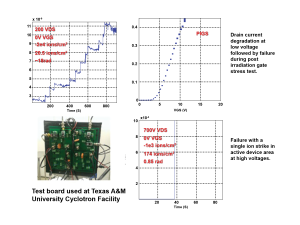
Leveraging our vast expertise in SiC-based semiconductor fabrication and our unparalleled proficiency in utilizing modeling and simulation tools for design optimization, we have been working diligently to resolving the critical issues of SEB and SEGR failures in SiC-based power devices. Through meticulous modeling and simulation to define optimal design parameters and stringent control over fabrication processes, we’ve made substantial progress in overcoming these challenges.
We are proud to announce the successful demonstration of our radiation-hardened SiC-based power switches, showcasing impressive SEB threshold voltages of 900 to 1000V under heavy ion exposure with Linear Energy Transfer (LET) exceeding 40 MeVcm2/mg and fluence of no less than 105 ions/cm2.
Our latest achievements have us looking to the stars with renewed optimism. By overcoming voltage limitations of current technology we are forging a path towards a new era of space exploration, empowering humanity to embark on once-impossible journeys.
About CoolCAD:
CoolCAD Electronics is a leader in the design, development, and fabrication of SiC-based power devices and high-temperature semiconductor electronics for aerospace, automotive, defense, geothermal development, green energy production, industrial furnace control, water purification, and oil and gas extraction. The CoolCAD team possesses a unique combination of expertise in electronics, semiconductor physics, fabrication, and design. They also excel at integrated and board-level circuit development and manufacturing. They have published 100s of research papers in professional scientific and engineering journals and have multiple patents on their key discoveries in the area of wide bandgap SiC electronics. To learn more about CoolCAD visit https://coolcadelectronics.com/